
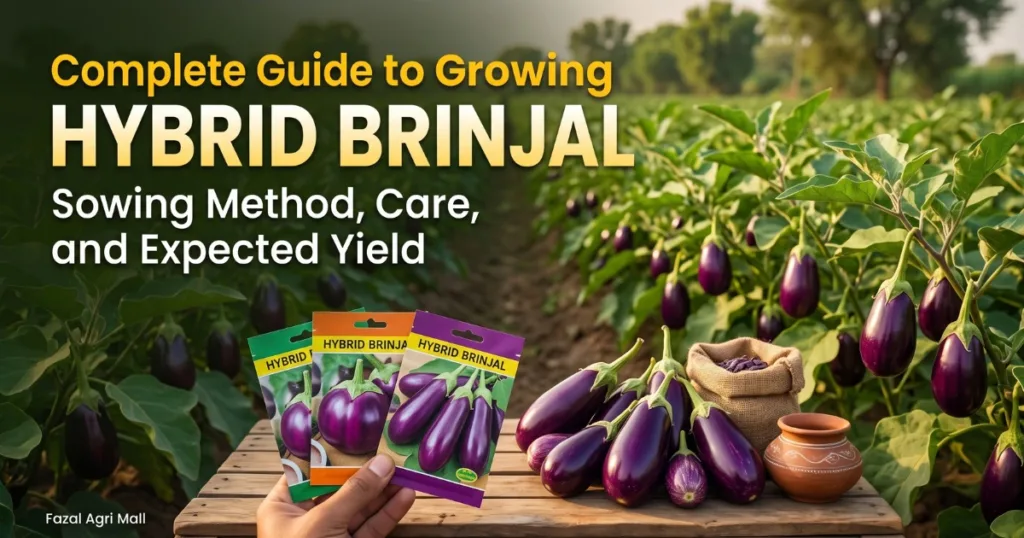
Complete Guide to Growing Hybrid Brinjal: Sowing Method, Care and Expected Yield
Table of Contents
Brinjal, commonly known as baingan, is one of the most popular vegetables grown and consumed in Pakistan. With increasing demand for fresh, attractive and high-quality vegetables, many farmers are turning toward hybrid brinjal varieties for better plant growth, uniform fruits and improved production potential.
However, growing hybrid brinjal successfully requires more than simply planting seeds. Proper nursery management, timely transplanting, suitable spacing, irrigation, balanced nutrition, pest control and harvesting all play an important role in achieving a profitable crop.
In this complete guide, fazalagrimall explains the essential steps for growing hybrid brinjal, from seed sowing to harvesting, along with practical crop-care tips and expected yield considerations.
Best Conditions for Growing Hybrid Brinjal
Brinjal is a warm-season crop and performs best when provided with suitable warmth, sunlight, fertile soil and consistent moisture.
For successful brinjal cultivation, choose land that receives plenty of sunlight and has good drainage. Waterlogged soil can damage roots and increase disease problems.
A well-drained soil rich in organic matter is generally suitable. Extension recommendations commonly place suitable soil pH around 6.5–7.5.
Ideal Conditions
- Warm weather
- Full sunlight
- Fertile soil
- Good drainage
- Adequate organic matter
- Reliable irrigation
- Good air circulation
Before planting, farmers should also consider the crop history of the field. Avoid repeatedly planting brinjal and other closely related crops in the same location because crop rotation can help reduce certain pest and disease pressures.
Hybrid Brinjal Sowing Method
The brinjal sowing method generally begins with raising healthy seedlings in a nursery before transplanting them into the main field.
This method gives farmers greater control over early plant development and allows weak or unhealthy seedlings to be removed before field planting.
Select Quality Hybrid Seeds
Start with certified, genuine and properly stored hybrid brinjal seeds from a reliable source.
Seed quality is extremely important because poor-quality seed can result in weak germination, uneven plant growth and reduced production.
When selecting seeds, consider:
- Hybrid performance
- Fruit size and colour
- Maturity period
- Disease tolerance or resistance where available
- Local climate suitability
- Market preference
- Recommended sowing season
Prepare the Nursery
Brinjal is commonly raised in a nursery and later transplanted into the field.
Prepare a clean, well-drained nursery bed with fine soil and well-decomposed organic matter. Raised nursery beds can be particularly useful where drainage is a concern.
Seeds can be sown in shallow lines rather than broadcast randomly. Agricultural recommendations commonly use shallow sowing and line spacing to improve seedling management.
Nursery Tips
- Use clean nursery soil or growing media.
- Avoid excessive irrigation.
- Maintain adequate moisture.
- Protect young seedlings from extreme weather.
- Monitor regularly for damping-off and other problems.
- Remove unhealthy seedlings promptly.
- Provide adequate light after germination.
Healthy seedlings should develop sturdy stems and several true leaves before transplanting.
Seed Sowing Depth
Avoid planting hybrid brinjal seeds too deeply.
A shallow sowing depth of approximately 0.5–1 cm is commonly recommended depending on the growing medium and seed type. Agricultural guidance for brinjal commonly recommends about 1 cm depth.
After sowing, cover the seeds lightly with fine soil or suitable growing material and irrigate gently.
Heavy watering immediately after sowing can disturb the seeds and reduce uniform emergence.
Nursery Seedling Care
Once seedlings emerge, careful management becomes essential.
Give seedlings adequate sunlight and avoid keeping the nursery continuously saturated with water. Excess moisture can encourage fungal and damping-off problems.
Water according to soil moisture rather than following a rigid daily schedule.
Before transplanting, seedlings should gradually be exposed to outdoor conditions. This hardening process can reduce transplant shock.
Healthy seedlings should be:
- Strong and compact
- Free from visible disease
- Green and healthy
- Well-rooted
- Able to stand upright
- Developed enough for transplanting
Depending on the hybrid and growing conditions, seedlings may become ready for transplanting several weeks after sowing. Extension recommendations vary, with many systems using approximately 30–40 days under suitable conditions.
Prepare the Main Field
Before transplanting, prepare the field thoroughly.
Plough the soil properly and remove large weeds, crop residues and stones. Incorporate well-decomposed organic matter where appropriate.
Good field preparation helps create a suitable root environment and improves drainage.
If the soil is heavy or drainage is poor, raised beds or ridges can be beneficial.
Transplanting Hybrid Brinjal Seedlings
Transplant healthy seedlings carefully to avoid damaging their roots.
Transplanting during the cooler part of the day, such as late afternoon, can reduce heat stress. Light irrigation after transplanting helps settle the soil around the roots.
Do not bury the stem unnecessarily deep.
Recommended Spacing
Spacing depends on the hybrid’s growth habit, soil fertility and cultivation system.
A commonly used spacing range is approximately:
60 cm × 35–60 cm
Some cultivation recommendations use around 60 cm between rows and 35–40 cm between plants, while other systems use wider spacing for vigorous plants.
Always prioritize the seed supplier’s recommended spacing when available.
Hybrid Brinjal Plant Care
Good brinjal plant care throughout the growing season is essential for strong growth and consistent fruit production.
Irrigation
Brinjal requires consistent moisture, particularly during flowering and fruit development.
However, excessive irrigation can create waterlogging and root problems.
A good approach is to maintain relatively even soil moisture without allowing the field to remain saturated.
Increase attention to irrigation during:
- Flowering
- Fruit setting
- Fruit development
- Hot and dry weather
Avoid unnecessary fluctuations between very dry and excessively wet conditions.
Fertilizer Management
Balanced nutrition is essential for productive brinjal farming in Pakistan.
Before applying fertilizer, consider soil fertility and, where possible, use soil testing to understand nutrient requirements.
Organic matter can help improve soil structure, while balanced nutrients support vegetative growth, flowering and fruit development.
Avoid excessive nitrogen application. Too much nitrogen can encourage excessive leaf growth at the expense of balanced fruit production.
A practical fertilizer program should consider:
- Soil condition
- Hybrid requirements
- Crop stage
- Irrigation availability
- Previous crop
- Soil-test recommendations
Weed Management
Weeds compete with brinjal plants for:
- Water
- Nutrients
- Sunlight
- Growing space
Keep the field reasonably weed-free, especially during early crop establishment.
Hand weeding, hoeing, mulching and other locally appropriate weed-management practices can be used depending on the farming system.
Pest Management
Pests can seriously affect the quality and productivity of the brinjal crop.
Common brinjal pests can include:
- Shoot and fruit borer
- Aphids
- Thrips
- Mites
- Whiteflies
- Caterpillars
Regular field scouting is one of the most important steps in pest management.
Check leaves, shoots, flowers and developing fruits frequently. Early detection allows farmers to respond before pest populations become difficult to manage.
Use integrated pest management practices where possible, including field sanitation, monitoring, biological options, mechanical removal and only appropriately registered crop-protection products when necessary.
The Government of Khyber Pakhtunkhwa’s crop information also lists several sucking pests, fruit and shoot borer, mites, aphids and multiple disease problems affecting brinjal.
Disease Management
Common diseases and disorders associated with brinjal can include:
- Damping-off
- Wilt
- Fruit rot
- Phomopsis blight
- Root-knot nematodes
- Other fungal and bacterial problems
Good drainage, healthy planting material, crop rotation, field sanitation and careful irrigation can help reduce disease pressure.
Do not ignore the first signs of disease. Early identification is usually easier to manage than a heavily affected crop.
Flowering and Fruit Development
Once the hybrid brinjal plants establish properly, flowering begins.
At this stage, consistent irrigation and balanced nutrition become particularly important.
Avoid severe moisture stress during flowering because unfavorable growing conditions can affect flower retention and fruit setting.
Good sunlight and sufficient spacing also help maintain airflow within the crop canopy.
When to Harvest Hybrid Brinjal?
One of the biggest mistakes in brinjal production is waiting too long to harvest.
Brinjal fruits are generally harvested while they are still tender, glossy and at the commercially preferred size.
The exact harvesting stage depends on the hybrid and market requirements.
Signs of Harvest Readiness
- Fruit has developed its expected colour.
- Skin remains glossy.
- Fruit has reached marketable size.
- Seeds have not become excessively hard.
- Fruit remains firm but tender.
Regular harvesting can encourage continued production.
Instead of allowing oversized fruits to remain on the plant, farmers should follow the maturity characteristics of their particular hybrid.
Expected Hybrid Brinjal Yield Per Acre
The brinjal yield per acre can vary significantly.
It depends on:
- Hybrid genetics
- Soil fertility
- Plant population
- Sowing time
- Irrigation
- Fertilizer management
- Pest and disease control
- Harvesting frequency
- Weather conditions
- Farmer management
Therefore, it is better not to promise one fixed yield for every hybrid.
For example, Punjab Agricultural University reports substantial yield differences among brinjal cultivars and hybrids, demonstrating how strongly variety and management can influence production. One listed hybrid, PBH-3, has an average yield of 257 quintals per acre under its recommended conditions.
This figure should not be treated as a guaranteed yield for every hybrid or every Pakistani farm. Local conditions can produce very different results.
The best approach is to select a hybrid with documented performance in your region and manage the crop according to recommended agronomic practices.
How to Increase Hybrid Brinjal Production
Farmers looking to improve production should focus on the complete crop-management system rather than relying only on expensive seed.
Follow These Practices:
Start with quality seed
Choose genuine hybrid seed from a reliable supplier.
Raise healthy seedlings
Do not transplant weak, diseased or severely stressed plants.
Maintain proper spacing
Give plants enough room for sunlight, airflow and fruit development.
Manage irrigation carefully
Avoid both prolonged drought stress and waterlogging.
Use balanced nutrition
Feed the crop according to soil conditions and crop requirements.
Scout regularly
Inspect the field frequently for pests and diseases.
Harvest at the right stage
Regular harvesting can help maintain marketable fruit quality and continued production.
Keep field records
Record sowing date, transplanting date, fertilizer applications, pest observations, harvest quantities and market prices.
These records can help farmers make better decisions for the next crop.
Why Choose Hybrid Brinjal Seeds?
Hybrid seeds can be attractive to commercial growers because they may offer desirable characteristics such as uniformity, fruit quality, vigorous growth and strong production potential.
However, hybrid seed is not a replacement for good farming practices.
Even excellent genetics require:
Quality Seed + Healthy Nursery + Proper Transplanting + Balanced Nutrition + Irrigation + Pest Management + Timely Harvesting = Better Crop Performance
For farmers searching for hybrid brinjal seeds and other quality agricultural inputs, fazalagrimall aims to provide farmers and growers with useful information and access to agricultural products suitable for their farming needs.
Frequently Asked Questions About Hybrid Brinjal
1. What is the best method for sowing hybrid brinjal?
The recommended approach is generally to raise seedlings in a clean nursery and transplant healthy seedlings into the prepared field. This gives better control over early plant establishment.
2. How deep should brinjal seeds be planted?
Brinjal seeds are generally sown shallowly, commonly around 0.5–1 cm deep depending on the growing medium and production system.
3. How much spacing is required for brinjal plants?
Spacing varies according to hybrid and plant growth habit. Around 60 cm between rows with approximately 35–60 cm between plants is commonly used, but farmers should follow the hybrid’s recommended spacing.
4. How often should hybrid brinjal be watered?
Watering should maintain consistent soil moisture without causing waterlogging. Irrigation requirements increase during hot weather, flowering and fruit development.
5. What are common pests of brinjal?
Common pests include shoot and fruit borer, aphids, thrips, mites, whiteflies and caterpillars. Regular crop scouting helps detect problems early.
6. How can I get a higher brinjal yield per acre?
Use quality hybrid seed, raise healthy seedlings, maintain appropriate spacing, prepare fertile and well-drained soil, provide balanced nutrition and irrigation, control weeds and pests early and harvest fruits at the appropriate stage.
Final Thought
Growing hybrid brinjal successfully is a combination of good genetics and good farm management. Choosing quality hybrid brinjal seeds is only the first step. Farmers must also pay attention to nursery preparation, transplanting, spacing, irrigation, nutrition, pest management, disease prevention and timely harvesting.
With proper planning and consistent crop care, hybrid brinjal can become a productive and commercially valuable vegetable crop.
For quality agricultural products, farming guidance and solutions for modern growers, fazalagrimall is committed to supporting Pakistan’s farming community with useful resources and agricultural products.
Start with quality seeds, manage every growth stage carefully and give your hybrid brinjal crop the conditions it needs to perform at its best.
For premium hybrid vegetable seeds and expert farming solutions contact fazalagrimall today and choose the right seeds for a healthier, higher-yield harvest.


No Comments