
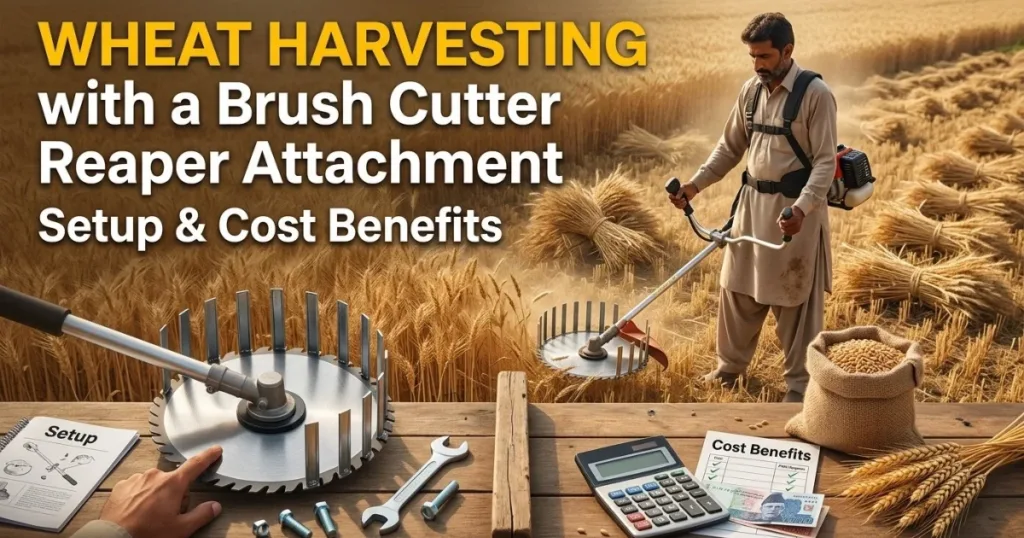
Wheat Harvesting with a Brush Cutter Reaper Attachment: Setup & Cost Benefits
Table of Contents
Wheat harvesting is one of the most important stages of the farming season in Pakistan. Completing the harvest on time helps farmers protect grain quality, reduce crop losses and prepare their fields for the next crop. However, traditional harvesting methods can require significant labor, time and effort. This is where a brush cutter reaper attachment for wheat harvesting can offer a practical alternative for suitable small and medium-sized farms.
A brush cutter reaper attachment is designed to cut standing crops using a cutting mechanism connected to a compatible power unit. Depending on the model, it may help farmers harvest wheat more efficiently without investing in a larger harvesting machine. Before purchasing one, farmers should understand how the attachment works, how to set it up, what it costs to operate and whether it suits their field conditions.
In this guide, we explain the setup process, operating considerations, potential cost benefits and important buying tips to help Pakistani farmers make an informed decision.
What Is a Brush Cutter Reaper Attachment for Wheat Harvesting?
A brush cutter reaper attachment is a crop-cutting accessory designed to work with a compatible brush cutter or power unit. Unlike a standard brush cutter blade used for grass and weeds, a reaper attachment uses a suitable cutting assembly to harvest standing crops.
For wheat harvesting, the attachment should be specifically designed or approved for cereal crops. Not every brush cutter can safely or effectively operate a reaper attachment, so checking compatibility is essential.
Farmers may consider this equipment when they need a compact harvesting solution for smaller plots, irregular fields or locations where larger machinery is difficult to use.
Key Features to Consider
- Cutting width: Determines how much crop can be cut in one pass.
- Cutting mechanism: A suitable reciprocating blade or manufacturer-approved cutting assembly can help cut wheat stems.
- Power compatibility: The engine or power unit must meet the attachment’s requirements.
- Cutting height: Appropriate adjustment helps achieve a more consistent cut.
- Weight and handling: A manageable design can reduce operator fatigue.
- Spare parts availability: Accessible blades and service support can help reduce downtime during harvest.
The actual performance of an attachment depends on its design, engine power, crop density, field conditions and operator experience.
How to Set Up a Brush Cutter Reaper Attachment for Wheat Harvesting
Correct setup is essential for safe operation, clean cutting and reliable performance. Always follow the equipment manufacturer’s instructions before fitting or operating the attachment.
Check Compatibility
Confirm that the attachment is compatible with your brush cutter or power unit. Check the required engine power, shaft type, mounting arrangement, drive connection and any manufacturer-specified operating limits.
Avoid improvised fittings or modifications that have not been approved by the manufacturer.
Inspect the Cutting Assembly
Before installation, inspect the cutting blade, guards, fasteners, drive components and mounting points. Make sure all parts are secure and free from visible damage.
Never operate equipment with a cracked blade, loose fasteners, damaged guards or worn components that could create a safety risk.
Attach the Reaper Mechanism
Switch off the engine and disconnect the spark plug lead or isolate the power source as directed in the manual. Fit the attachment using the specified mounting procedure and tools.
Confirm that the drive connection is secure and that the cutting assembly moves as intended when checked according to the manufacturer’s instructions.
Adjust the Cutting Height
Set the cutting height according to the attachment design, wheat condition and manufacturer’s guidance. A consistent cutting height can help improve harvesting results and reduce unnecessary cutting of soil or stubble.
Avoid setting the cutting mechanism too low, particularly on uneven fields.
Prepare the Wheat Field
Before harvesting, inspect the field for stones, wire, irrigation equipment and other obstructions. Check whether the wheat is sufficiently mature and whether the crop is dry enough for the intended harvesting and post-harvest handling method.
Very wet, lodged or excessively dense wheat may reduce cutting efficiency and increase the risk of blockages.
Conduct a Controlled Test
Start the machine only after confirming that all guards are installed and everyone is clear of the cutting area. Test the equipment in a small section of the field, following the manufacturer’s starting and operating instructions.
Observe cutting quality, crop handling, vibration and machine behavior. Stop the engine and isolate the power source before clearing a blockage or making an adjustment.
How to Harvest Wheat Efficiently with a Reaper Attachment
Once the attachment has been installed and tested, careful operation can help improve productivity.
Maintain a steady working pace: Moving too quickly may result in missed stems, uneven cutting or crop accumulation. Follow the manufacturer’s recommended operating speed and feed rate.
Work in manageable rows: Organize the field into practical passes that suit its shape and the machine’s cutting width. Avoid sharp or unsafe movements.
Monitor crop flow: Watch for bunching, clogging or uneven cutting. Stop the equipment safely before investigating any problem.
Handle cut wheat properly: Depending on the machine design, cut wheat may require manual collection, bundling or further handling. Do not assume that a reaper attachment threshes or cleans grain unless the equipment is specifically designed to do so.
Check grain moisture and storage needs: After cutting, handle and dry the crop appropriately before storage or threshing. Harvesting efficiently is only one part of protecting grain quality.
Cost Benefits of a Brush Cutter Reaper Attachment
One of the main reasons farmers consider a brush cutter reaper attachment is the possibility of reducing harvesting expenses. However, the actual savings depend on the purchase price, field size, labor rates, operating costs and cutting performance.
Potential Reduction in Labor Expenses
Manual wheat harvesting can require multiple workers, particularly when a large area must be harvested within a limited period. A suitable mechanical cutting attachment may reduce the number of workers needed for the cutting stage.
However, labor may still be required for collecting, bundling, transporting or threshing the crop.
Faster Harvesting on Suitable Fields
When field conditions and machine performance are favorable, mechanical cutting may complete the harvesting stage faster than manual cutting. This can be particularly valuable when farmers need to harvest before adverse weather or crop deterioration.
Actual field capacity should be confirmed through a practical demonstration rather than relying only on advertised specifications.
Lower Initial Investment Than Some Larger Machines
A compatible attachment may cost less to purchase than a complete, larger harvesting machine. This can make it worth evaluating for smaller farms or farmers who do not need the capacity of a combine harvester.
Nevertheless, compare the total cost of the attachment, compatible power unit, installation, maintenance and required manual work before making a decision.
Flexible Use Across Suitable Areas
Compact equipment may be easier to transport and maneuver in smaller or irregularly shaped fields. Its usefulness will depend on field access, crop layout, terrain and operator skill.
Better Harvest Scheduling
Reducing the time needed for crop cutting may help farmers organize labor and post-harvest operations more effectively. Timely harvesting can be important when weather conditions are changing or the next crop must be planted promptly.
Brush Cutter Reaper Attachment vs. Manual Wheat Harvesting
| Factor | Brush Cutter Reaper Attachment | Manual Harvesting |
| Cutting method | Mechanized cutting | Hand tools and manual labor |
| Initial cost | Equipment purchase and setup required | Usually lower equipment cost |
| Labor needs | May reduce cutting labor | Often requires more workers |
| Harvesting speed | Depends on field conditions and machine capacity | Depends on worker availability and pace |
| Maintenance | Requires inspection, servicing and spare parts | Requires basic tool maintenance |
| Field suitability | Depends on terrain, crop density and equipment design | Can be practical in small or difficult-to-access areas |
| Crop handling | Collection or bundling may still be needed | Workers can cut and collect wheat together, depending on the method |
Which option is better? A brush cutter reaper attachment may suit farmers who have compatible equipment and need a compact mechanized cutting solution. Manual harvesting may remain practical where plots are very small, terrain is difficult or equipment costs cannot be justified.
How to Calculate Your Wheat Harvesting Cost Savings
Farmers should compare the complete cost of both methods instead of looking only at the purchase price.
Use this simple calculation:
Manual harvesting cost per acre = Labor and other harvesting expenses per acre.
Mechanical harvesting cost per acre = Fuel + operator labor + maintenance + attachment cost allocated per acre + remaining collection and handling expenses.
Estimated savings per acre = Manual harvesting cost per acre − Mechanical harvesting cost per acre.
For example, if mechanical cutting costs less per acre than manual cutting after including all related expenses, the difference represents the potential saving. Actual figures should come from local labor rates, fuel prices, equipment quotations and field trials.
To estimate how much the attachment could save over several seasons, also account for repairs, replacement parts, downtime and the number of acres harvested each year.
Important Buying Tips for Pakistani Farmers
Before purchasing a brush cutter reaper attachment, consider the following points:
- Confirm that the attachment is suitable for wheat, not just grass or weeds.
- Check compatibility with your existing power unit.
- Ask for the cutting width, recommended operating conditions and expected field capacity.
- Request a live demonstration on a wheat crop similar to yours.
- Compare the full package price, including the power unit if required.
- Check warranty coverage, service availability and replacement blade costs.
- Ask whether the machine leaves wheat in manageable rows or requires additional collection work.
- Calculate the cost per acre using your own labor and fuel expenses.
For farmers in Punjab and other wheat-growing regions of Pakistan, local service support and spare-part availability can be especially important during the short harvesting window.
Safety Tips When Operating a Reaper Attachment
Mechanical harvesting equipment must be handled carefully. Follow the manufacturer’s safety instructions at all times.
- Wear appropriate eye protection, hearing protection, sturdy footwear and other recommended protective equipment.
- Keep children, bystanders and animals away from the working area.
- Never remove safety guards while the machine is running.
- Switch off and isolate the power source before cleaning, servicing or removing blockages.
- Do not operate the equipment if the blade, shaft or mounting assembly is damaged.
- Avoid loose clothing that could become caught in moving components.
- Stop work if excessive vibration, unusual noise or unstable operation occurs.
If the attachment is not designed for the brush cutter you own, do not attempt to force a fit. Choose equipment that meets the manufacturer’s specifications.
Conclusion
Wheat harvesting with a brush cutter reaper attachment can be a useful option for farmers looking for a compact alternative to manual crop cutting. With correct setup, compatible equipment, suitable field conditions and proper maintenance, it may help improve cutting efficiency and manage harvesting expenses.
However, the best choice depends on more than the machine’s purchase price. Farmers should compare labor requirements, fuel consumption, cutting performance, crop collection needs and servicing costs before investing.
For practical agricultural equipment guidance and farming solutions, Fazal Agri Mall supports farmers in making informed decisions that suit their crops, fields and budgets. Explore suitable agricultural products and compare your options before the wheat harvesting season begins.
Frequently Asked Questions (FAQs)
1. Can a brush cutter reaper attachment be used for wheat harvesting?
Yes, if the attachment is specifically designed for wheat or cereal crops and is compatible with the power unit. Standard grass-cutting blades should not be assumed suitable for harvesting wheat.
2. How much does a brush cutter reaper attachment cost in Pakistan?
The price varies by model, cutting width, build quality, included accessories and whether a compatible power unit is included. Request current quotations from local suppliers and compare the complete setup cost before buying.
3. Is a reaper attachment cheaper than manual wheat harvesting?
It may reduce cutting costs when labor savings outweigh fuel, maintenance, equipment depreciation and operator expenses. The result depends on the number of acres harvested and local labor rates.
4. Can one person operate a brush cutter reaper attachment?
Some models are designed for individual operation, while others may require additional help for safe handling or crop collection. Always follow the model-specific operating instructions and never assume that one-person operation is appropriate for every design.
5. Does a brush cutter reaper attachment also thresh wheat?
Usually, a cutting attachment only cuts the standing crop. Threshing, cleaning and grain separation generally require separate equipment unless the machine is specifically designed to perform those functions.
6. What should farmers check before buying a wheat reaper attachment?
Check compatibility, cutting width, crop suitability, safety guards, spare parts, warranty, service support and demonstrated field performance. Calculate the total cost per acre to determine whether the equipment is a sensible investment for your farm.
Final Thought
Smart farming is not only about buying new machinery; it is about choosing the right equipment for the right job. A properly selected brush cutter reaper attachment may help make wheat harvesting more manageable, but careful cost calculations and safe operation are essential. Before investing, compare your options and choose a solution that supports long-term farm productivity with fazalagrimall.
For expert guidance on agricultural machinery and wheat harvesting solutions, contact Fazal Agri Mall today and find the right equipment for your farming needs.



No Comments