
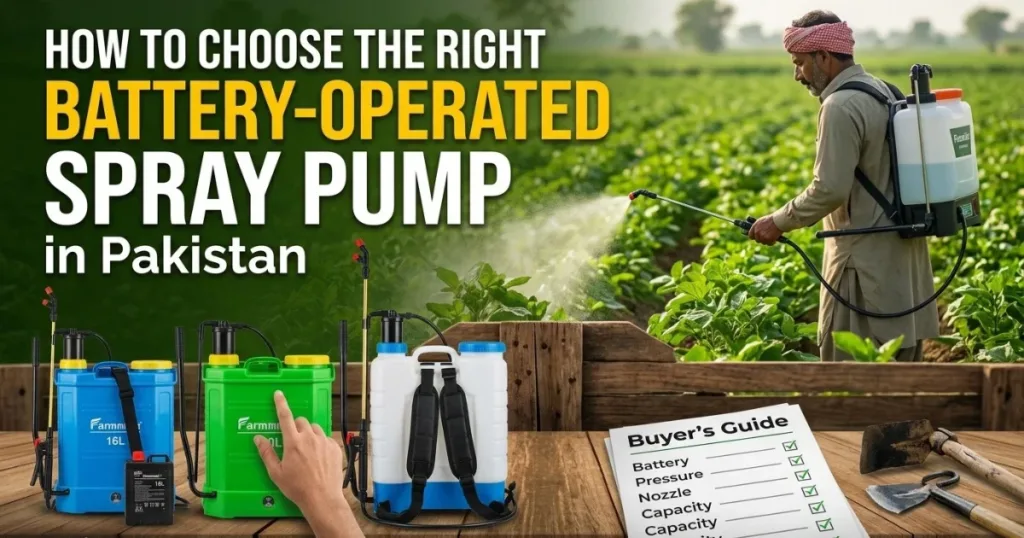
How to Choose the Right Battery-Operated Agricultural Spray Pump in Pakistan
Table of Contents
Modern farming requires the right equipment to protect crops, save time and improve spraying efficiency. A battery-operated agricultural spray pump in Pakistan is a practical choice for farmers who want to spray pesticides, insecticides, fungicides and foliar fertilizers without continuously operating a manual pump. It can make routine crop spraying easier, especially in vegetable fields orchards, gardens and small to medium-sized farms.
However, choosing the right spray pump is not just about finding the lowest price. Battery capacity, tank size, spray pressure, nozzle quality, durability and after-sales support all influence performance.
In this guide, we explain how to choose the best battery-operated agricultural spray pump for your farming needs, what features to compare and how to maintain your equipment for long-term use.
What Is a Battery-Operated Agricultural Spray Pump?
A battery-operated agricultural spray pump is a spraying device powered by a rechargeable battery. It uses an electric motor and pump mechanism to draw liquid from a tank and deliver it through a hose, lance and nozzle.
Unlike a traditional manual sprayer, it does not require continuous hand pumping during normal operation. This can reduce repetitive effort and help farmers maintain a more consistent spraying routine.
Battery-operated spray pumps are commonly used for:
- Spraying approved pesticides and insecticides on crops.
- Applying fungicides to manage fungal diseases.
- Applying suitable foliar fertilizers.
- Treating vegetable crops orchards and fruit trees.
- Spraying plants in nurseries, kitchen gardens and greenhouses.
The right model depends on your farm size, crop type, spraying frequency and the type of agricultural products you need to apply.
Choose the Right Tank Capacity
Tank capacity is one of the first features to consider when buying a battery-operated agricultural spray pump in Pakistan. A suitable tank reduces unnecessary refilling while keeping the equipment manageable.
Consider the following general guidelines:
- 12-litre tank: May suit small gardens, nurseries and light spraying tasks.
- 16-litre tank: A practical option for routine spraying in small to medium-sized fields.
- 20-litre tank: May suit larger spraying jobs where carrying a heavier tank is manageable.
These are general examples, not strict rules. The best capacity depends on the crop, application rate, operator comfort and field conditions.
Before purchasing, check the filled weight of the sprayer. A larger tank can reduce refill trips, but it also adds weight to the operator’s back and shoulders.
Check Battery Capacity and Backup Time
Battery performance directly affects how long you can work before recharging. When comparing battery-operated spray pumps, check the battery type, voltage, amp-hour rating, charging time and manufacturer’s stated operating duration.
A higher amp-hour rating can indicate greater battery capacity when comparing batteries of the same voltage and type. However, actual operating time also depends on pump pressure, nozzle selection, battery condition and usage.
Before buying, ask these questions:
- How long does the battery operate under normal spraying conditions?
- How much time is required for a full charge?
- Is the battery replaceable?
- Is a compatible charger included?
- Can replacement batteries be purchased locally?
Choose a model with sufficient runtime for your normal spraying schedule. Do not rely solely on advertised backup claims; actual performance may vary.
Compare Spray Pressure and Flow Rate
Spray pressure and flow rate determine how liquid is delivered through the nozzle. A suitable combination helps achieve the required coverage without unnecessary waste.
When comparing an agricultural spray pump, check its rated pressure, flow rate and nozzle compatibility.
Different applications may require different spray patterns:
- Fine spray: Can provide coverage for certain applications when permitted by the product label and weather conditions.
- Medium droplets: May be suitable for many routine crop-spraying applications.
- Coarser droplets: Can help reduce drift in suitable conditions, depending on the product and target.
Higher pressure is not always better. Excessively fine droplets can drift away from the target, while unsuitable pressure may cause poor coverage or runoff. Select the nozzle and operating pressure according to the pesticide label, crop requirements and local conditions.
Select a Durable and Comfortable Design
Agricultural spraying often involves walking through fields, working in warm weather and carrying equipment for extended periods. A comfortable, durable sprayer can make these tasks easier.
Look for the following features:
- Adjustable and padded shoulder straps.
- A comfortable tank shape and secure harness.
- Chemical-resistant tank and seals compatible with the intended products.
- A sturdy hose and leak-resistant connections.
- A comfortable spray handle and reliable trigger.
- A stable base and easy-to-use controls.
Inspect the tank, lid, hose connections and lance before purchasing. If possible, ask the seller to demonstrate the pump with clean water so you can check for leaks and confirm that the motor and spray controls work properly.
Check the Pump Motor and Nozzle Options
The pump motor helps move liquid from the tank to the nozzle. Its performance influences pressure stability and liquid delivery.
A good agricultural spray pump should provide specifications that are easy to verify. Ask the seller about the pump type, rated output, compatible nozzles and availability of replacement parts.
Multiple nozzle options can be useful when your work involves different crops or application requirements. However, more nozzles do not automatically mean better performance. The important point is whether the available nozzles suit your intended use.
Before purchasing, confirm that replacement nozzles, filters, hoses, seals and other commonly worn components are available.
Compare Battery-Operated Spray Pump Prices in Pakistan
The price of a battery-operated spray pump in Pakistan can vary according to tank capacity, battery specifications, motor performance, included accessories, build quality and warranty coverage.
Rather than choosing the cheapest model immediately, compare the complete package.
| Feature | What to check |
| Tank capacity | Suitable for your field and crop |
| Battery | Type, voltage, capacity and replacement availability |
| Runtime | Verified operating duration under normal use |
| Charging | Charger included and charging time specified |
| Pressure and flow | Appropriate for your spraying requirements |
| Accessories | Lance, hose, nozzles, filters and straps |
| Warranty | Clear coverage and service conditions |
| Spare parts | Availability of batteries and pump components |
Ask whether the quoted price includes the charger, delivery, warranty and essential accessories. Also consider the cost of replacement batteries and routine maintenance.
The best-value pump is one that meets your spraying needs reliably and can be maintained without excessive expense.
Choose a Pump Suitable for Your Crops
Different crops have different spraying requirements. Before choosing a model, consider plant height, row spacing, field size, canopy density and the type of treatment you plan to apply.
For Vegetable Farming
Vegetable crops such as tomatoes, chillies, cucumbers and brinjal may need regular monitoring and carefully targeted spraying. A manageable tank, suitable nozzle options and consistent spray delivery can be helpful.
For Orchards and Fruit Trees
Fruit trees may require suitable reach and coverage within the canopy. Check whether the lance and nozzle arrangement can reach the intended target safely. A backpack sprayer may not be the best option for every tall tree or large orchard.
For Wheat and Other Field Crops
For larger fields, calculate the time and refilling required to cover the area. A backpack sprayer may be suitable for spot treatments or smaller plots, while larger farms may benefit from tractor-mounted or other high-capacity spraying systems.
For Kitchen Gardens and Nurseries
A smaller, lightweight model may be easier to handle in confined spaces. Choose an appropriate nozzle and use only products approved for the crop and intended application.
Check Warranty, Spare Parts and After-Sales Support
A spray pump is a working tool, so access to maintenance and replacement components matters. A low-cost model may become expensive if the battery fails or essential parts cannot be found.
Before ordering, ask the seller about:
- Battery and charger warranty.
- Availability of replacement batteries.
- Repair or service options.
- Replacement nozzles, hoses, filters and seals.
- Return or exchange conditions.
- Delivery arrangements and support after purchase.
Keep the purchase receipt and warranty information. Following the manufacturer’s charging and storage instructions can also help extend battery life.
Learn How to Maintain Your Battery Sprayer
Proper maintenance helps protect the pump, battery, seals and nozzle. After each spraying session, follow the product label and equipment manufacturer’s cleaning instructions.
Useful maintenance practices include:
- Clean the tank and flush the system using the method specified by the product label and manufacturer.
- Remove and clean compatible filters and nozzles when required.
- Inspect the hose, seals, trigger and connections for leaks or damage.
- Switch off the unit before inspection or servicing.
- Charge the battery using the supplied or approved charger.
- Store the equipment in a cool, dry, secure place away from children and direct sunlight.
- Keep the sprayer clearly identified and never reuse it for drinking water or food-related purposes.
Never pour leftover pesticide into drains, canals or water sources. Follow the product label and local guidance for handling and disposal of leftover spray mixtures and rinse water.
Follow Agricultural Spraying Safety Practices
A battery-powered sprayer reduces manual pumping, but it does not remove the risks associated with agricultural chemicals.
Always read the pesticide label before mixing or spraying. Wear the specified personal protective equipment, including suitable gloves, protective clothing, eye protection and respiratory protection where required.
Avoid spraying in strong winds or conditions that increase drift. Keep people and animals away from the application area as directed by the product label. Do not exceed the recommended concentration or application rate.
Never mix pesticides unless the labels explicitly permit the combination. Observe re-entry intervals, pre-harvest intervals and other restrictions. If a chemical comes into contact with your skin or eyes, follow the label’s first-aid instructions and seek medical help when necessary.
Safe application protects the farmer, the crop, nearby people and the environment.
Frequently Asked Questions (FAQs)
1. Which battery-operated agricultural spray pump is best in Pakistan?
The best model depends on your farm size, crop type, required runtime, tank capacity, pressure and budget. Compare verified specifications, warranty coverage and spare-part availability before purchasing.
2. What tank capacity is suitable for a battery spray pump?
A 12-litre model may suit gardens and small plots, while 16-litre and 20-litre models may be useful for larger spraying tasks. Choose a capacity that balances fewer refills with comfortable carrying weight.
3. How long does a battery-operated spray pump last on one charge?
Runtime varies by battery capacity, pump pressure, nozzle, battery condition and spraying method. Check the manufacturer’s stated runtime and, where possible, ask for a demonstration under normal operating conditions.
4. Is a battery-operated spray pump better than a manual spray pump?
A battery-operated pump reduces the need for repetitive manual pumping and can make longer spraying sessions more convenient. A manual pump may be less expensive and simpler to maintain. The right option depends on your workload, budget and access to charging.
5. Can I use a battery spray pump for pesticides and fertilizers?
Many models can apply compatible agricultural pesticides and foliar fertilizers, but suitability depends on the equipment and the product. Check the sprayer manufacturer’s instructions and the chemical label before use. Clean the equipment as directed between applications.
6. What should I check before buying a battery spray pump online?
Check the tank capacity, battery specifications, operating time, charging requirements, nozzle options, included accessories, warranty, return policy and spare-part availability. Confirm the final price and delivery terms before placing your order.
Final Thought
Choosing the right battery-operated agricultural spray pump in Pakistan is an important step toward making crop spraying more convenient and efficient. The ideal model should match your farm size, provide suitable battery runtime, deliver the required spray pattern and offer reliable access to replacement parts and maintenance.
Do not make your decision based on price alone. Compare the specifications, consider operator comfort and prioritize safe, label-compliant spraying practices.
At fazalagrimall, our goal is to help Pakistani farmers make informed agricultural purchasing decisions with practical guidance for their everyday farming needs. Choose equipment that suits your crops, supports your workflow and offers dependable value over time.
For more information about agricultural spray pumps and quality farming equipment, contact fazalagrimall today and let us help you choose the right solution for your farming needs!


No Comments