
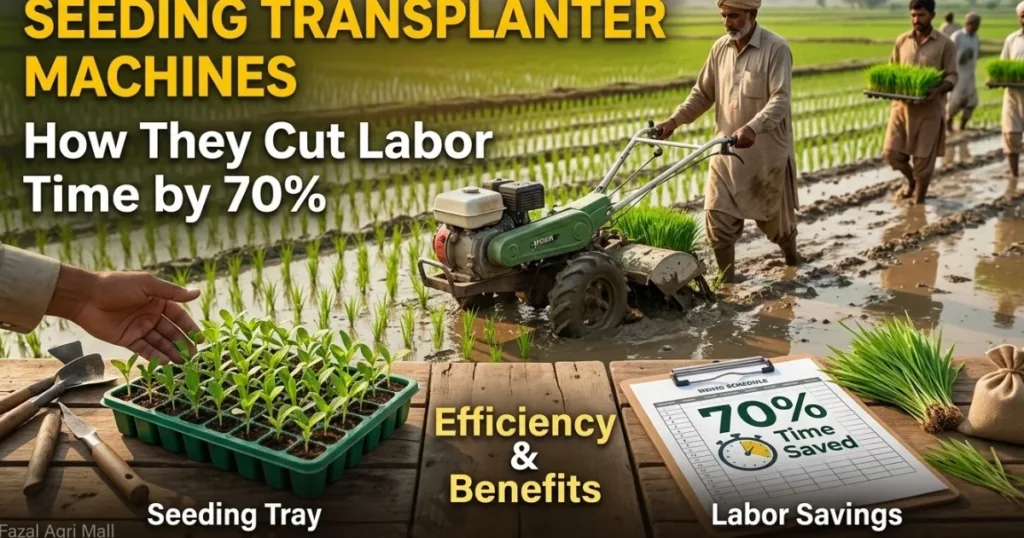
Seeding Transplanter Machines: How They Cut Labor Time by 70%
Table of Contents
Modern agriculture is evolving rapidly and farmers are increasingly adopting innovative machinery to improve productivity, reduce labor costs and save valuable time. One of the most effective solutions is seeding transplanter machines, which help farmers plant seeds or transplant seedlings more efficiently than traditional manual methods.
For farmers in Pakistan, where labor availability, rising wages and limited planting windows can create challenges, mechanized planting offers a practical way to improve farm operations. From vegetable cultivation to large-scale commercial farming, the right agricultural equipment can make planting faster, more consistent and easier to manage.
But how can seeding transplanter machines reduce labor time by up to 70%? In this guide, we explore how these machines work, their benefits, different types and how farmers can choose the right equipment for their needs.
What Is a Seeding Transplanter Machine?
A seeding transplanter machine is agricultural equipment designed to automate planting operations. Depending on its design, it can place seeds directly into the soil or transplant young seedlings grown in nurseries or seedling trays.
These machines help maintain consistent planting depth, spacing and row alignment while reducing the repetitive work associated with manual planting.
There are two main types:
- Seed planting machines: Place seeds directly into prepared soil at controlled depths and intervals.
- Seedling transplanter machines: Transfer young plants from nursery trays into fields, commonly for crops such as tomatoes, chilies, cabbage and other vegetables, depending on the machine.
Understanding the difference between a seed drill, precision planter and seedling transplanter helps farmers select equipment suitable for their crops and field conditions.
How Do Seeding Transplanter Machines Cut Labor Time by 70%?
The primary advantage of seeding transplanter machines is their ability to automate repetitive planting tasks. Instead of requiring workers to make holes, position seeds or seedlings, maintain spacing and cover the soil manually, mechanized equipment can complete several operations in a single pass.
A reduction of 70% in labor time is possible under suitable conditions, but actual results depend on the crop, machine capacity, field size, soil preparation and the manual planting method used for comparison.
Faster Planting Across Large Fields
Manual planting can be time-consuming, particularly when farmers need to cover several acres within a short period. A suitable transplanter can cover multiple rows in one pass, allowing farmers to complete planting operations more quickly.
This advantage is especially valuable during peak sowing seasons when delays may affect crop establishment and production schedules.
Reduced Dependence on Manual Labor
Hiring and managing large planting teams can increase farm expenses. Seeding transplanter machines reduce the number of labor-hours required for repetitive planting tasks.
Although operators may still be needed to feed seedlings, monitor equipment and check planting quality, mechanization allows farmers to use their workforce more efficiently.
Consistent Seed and Seedling Spacing
Manual planting can result in uneven spacing and inconsistent planting depths. Precision planting equipment helps maintain more uniform distances between seeds or seedlings.
Better spacing can improve crop management, simplify weeding and irrigation and help plants access sunlight, water and nutrients more evenly.
Reduced Physical Fatigue
Planting crops manually often involves repetitive bending, walking and handling seeds or seedlings for long hours. Mechanized planting reduces much of this physical effort.
Workers can concentrate on monitoring equipment, preparing seedlings and performing other important farm activities.
Better Use of the Planting Season
Many crops need to be planted within specific seasonal windows to achieve satisfactory growth. A seeding transplanter machine helps farmers complete planting operations faster when weather and soil conditions are suitable.
This can be particularly beneficial for commercial vegetable growers who need to establish crops on time.
Types of Seeding Transplanter Machines
Different farms require different planting solutions. Choosing the right machine depends on crop type, farm size, budget and available power sources.
1. Manual Transplanter
Manual transplanters are suitable for small farms, kitchen gardens and growers seeking affordable planting tools. They simplify seedling placement but still require physical effort.
2. Semi-Automatic Transplanter
Semi-automatic transplanters are useful for small and medium-sized farms. Operators feed seedlings into the machine while the equipment handles operations such as soil opening and seedling placement.
These machines offer a balance between affordability and labor savings.
3. Tractor-Mounted Transplanter
Tractor-mounted transplanters are designed for larger agricultural operations. They can cover several rows simultaneously, increasing planting capacity and reducing the labor needed per acre.
They are particularly useful for commercial vegetable farming when the machine is compatible with the crop and field conditions.
4. Automatic Rice Transplanter
Automatic rice transplanters are specifically designed to transplant rice seedlings into prepared paddy fields. Depending on the model, they can plant multiple rows at once and reduce dependence on manual rice transplanting.
Farmers should select equipment designed for their particular crop rather than assuming every transplanter can handle every seedling type.
Key Benefits of Using Seeding Transplanter Machines
Investing in suitable agricultural planting equipment can provide several long-term benefits.
Lower Labor Costs
Mechanization can reduce the labor-hours needed for planting. This is particularly useful when seasonal workers are expensive or difficult to find.
Improved Planting Accuracy
Precision planting equipment can help maintain uniform spacing, planting depth and row alignment, making crop management easier.
Increased Farm Productivity
Faster planting allows farmers to spend more time on irrigation, fertilization, weed control and other essential agricultural activities.
Reduced Physical Work
Mechanized equipment reduces repetitive manual tasks and can improve working conditions for farm laborers.
More Efficient Seed Use
Precision seeders can help regulate seed placement and spacing. The actual savings depend on machine calibration, seed characteristics and crop requirements.
How to Choose the Best Seeding Transplanter Machine
Before purchasing a seeding transplanter machine, farmers should evaluate their requirements carefully.
Farm size: Select equipment with a working capacity suitable for the area you need to plant.
Crop type: Ensure the machine supports your specific seeds or seedlings.
Planting method: Decide whether you need a direct seed planter or a seedling transplanter.
Row spacing: Check whether the machine supports your preferred crop spacing.
Power requirements: Consider tractor compatibility, engine requirements and fuel consumption.
Maintenance costs: Evaluate spare parts, repairs, servicing and routine maintenance expenses.
Local availability: In Pakistan, access to replacement parts and technical support can be important factors when selecting agricultural machinery.
Comparing these factors helps farmers avoid unnecessary expenses and choose equipment that delivers practical value over time.
How to Calculate 70% Labor-Time Savings
Farmers can estimate the efficiency of a seeding transplanter machine by comparing the labor-hours needed to plant the same area using manual and mechanized methods.
Use this formula:
Labor-Time Reduction (%) = [(Manual Labor-Hours − Machine Labor-Hours) ÷ Manual Labor-Hours] × 100
For example, suppose manual planting requires 100 labor-hours, while machine-assisted planting requires only 30 labor-hours.
Labor-time reduction = [(100 − 30) ÷ 100] × 100 = 70%
This example demonstrates how the calculation works; it does not guarantee that every machine will achieve the same result.
For a fair comparison, include all workers involved in machine operation, seedling loading, field preparation where relevant and planting-related tasks. Also distinguish total labor-hours from elapsed clock time.
Common Mistakes to Avoid When Using Transplanter Machines
Even high-quality agricultural equipment may produce poor results if it is used incorrectly.
- Choosing the wrong machine: Select equipment designed for your crop and planting method.
- Ignoring soil preparation: Poor field conditions can affect planting depth and seedling establishment.
- Using inconsistent seedlings: Uniform, healthy seedlings are generally easier to transplant.
- Skipping calibration: Incorrect settings can cause uneven spacing and planting depth.
- Neglecting maintenance: Worn components and blocked mechanisms can reduce efficiency.
- Ignoring operating costs: Include fuel, repairs, depreciation and operator wages when calculating savings.
Proper training, routine inspections and correct machine settings can help farmers improve planting performance.
Frequently Asked Questions (FAQs)
1. What is a seeding transplanter machine used for?
A seeding transplanter machine automates planting operations. Seed planters place seeds directly into soil, while seedling transplanters move young plants from nursery trays or beds into agricultural fields.
2. Can seeding transplanter machines really reduce labor time by 70%?
Yes, a 70% reduction may be achievable under suitable conditions, but it is not guaranteed. Results depend on the machine, crop, field size, operator skill and the efficiency of the manual method used for comparison.
3. Which crops can be planted using a transplanter machine?
Depending on the equipment, transplanters can handle rice, tomatoes, chilies, cabbage, eggplant and other crops grown as seedlings. Direct-seeding machines can plant crops such as maize, wheat and various vegetables when designed for those seeds.
4. Are seeding transplanter machines suitable for small farmers in Pakistan?
Yes. Manual and walk-behind models may suit small farms, while tractor-mounted machines may be more appropriate for larger agricultural operations. Farmers should compare purchase prices, operating expenses, maintenance requirements and expected labor savings.
5. Do transplanter machines increase crop yield?
They can support better crop establishment through more consistent planting and timely field operations. However, higher yields are not guaranteed because seed quality, irrigation, soil fertility, weather and crop management also influence production.
6. How can I choose the right agricultural planting machine?
Consider your farm size, crop type, planting method, row spacing, soil conditions, power requirements, budget and spare-part availability. Request a demonstration when possible to evaluate planting quality and operating efficiency before purchasing.
Final Thought
Seeding transplanter machines are helping modern farmers reduce repetitive manual work, improve planting consistency and make agricultural operations more efficient. With the right equipment, proper calibration and effective crop management, farmers may achieve significant labor-time savings while maintaining planting quality.
However, choosing a machine should involve more than focusing on an advertised 70% reduction. Evaluate your farm’s requirements, calculate the potential return on investment and select equipment that offers reliable performance over the long term.
At fazalagrimall, our goal is to help farmers discover practical agricultural solutions, make informed equipment decisions and improve farming productivity. Explore modern farming practices with fazalagrimall and take a smarter step toward efficient, sustainable agriculture.
For expert guidance on seeding transplanter machines and modern agricultural equipment, contact fazalagrimall today and let us help you find the right solutions for your farming needs!


No Comments