
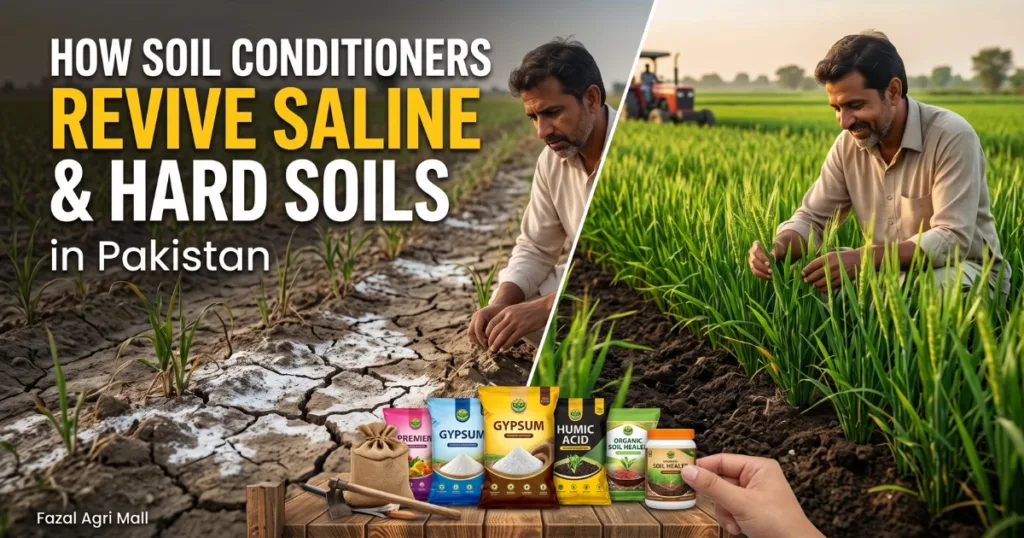
How Soil Conditioners Revive Saline and Hard Soils in Pakistan
Table of Contents
Healthy soil is the foundation of successful farming, but many farmers in Pakistan face serious challenges caused by saline soil, hard soil, poor drainage and low soil fertility. These problems can prevent crops from absorbing water and nutrients properly, resulting in weak plant growth and reduced yields. Fortunately, soil conditioners can help improve soil structure, manage certain salinity problems and create better conditions for healthy crop development.
Understanding how soil conditioners work is an important step toward improving agricultural productivity. Whether you grow wheat, rice, cotton, vegetables or fodder crops, choosing the right soil improvement strategy can help you make better use of your farmland.
In this guide, we will explore how soil conditioners revive saline and hard soils in Pakistan, their benefits, the types available and how farmers can use them effectively.
What Are Soil Conditioners?
Soil conditioners are materials added to soil to improve its physical structure, water movement, aeration or other important properties. Depending on their composition, they may help loosen compacted soil, improve water retention, support beneficial soil organisms or reduce the effects of certain soil-related problems.
Common soil conditioners include:
- Agricultural gypsum for suitable sodic soils.
- Compost and well-decomposed organic matter.
- Farmyard manure that is properly prepared.
- Biochar and other suitable organic amendments.
- Certain mineral-based soil amendments.
- Specialized commercial soil conditioners formulated for specific soil problems.
It is important to understand that not every soil conditioner works in the same way. The right product depends on the soil’s salinity, sodicity, texture, drainage and nutrient status.
Understanding Saline and Hard Soils in Pakistan
Pakistan’s agricultural land faces several soil management challenges, particularly in irrigated farming regions where salts can accumulate over time.
Saline Soil
Saline soil contains excessive amounts of soluble salts. These salts make it harder for plant roots to absorb water, even when moisture is present in the soil. As a result, crops may experience poor germination, slow growth and reduced productivity.
Common warning signs include a whitish salt crust on the soil surface, uneven crop growth and poor plant development. However, laboratory testing is needed to confirm the problem.
Hard and Compacted Soil
Hard soil may develop because of repeated machinery use, working the land when it is too wet, low organic matter or natural soil characteristics. Compaction restricts root growth, reduces air circulation and slows water infiltration.
When roots cannot penetrate the soil easily, crops may struggle to access the water and nutrients they need.
Sodic Soil
Sodic soil contains excessive exchangeable sodium, which can cause soil particles to disperse and form a dense, poorly structured surface. Water may collect on the surface instead of moving into the soil.
Although saline and sodic soils are sometimes confused, they require different management approaches. Soil testing helps determine which treatment is appropriate.
How Soil Conditioners Revive Saline and Hard Soils
Improve Soil Structure and Loosen Compacted Ground
Hard, compacted soil can limit the movement of air and water around plant roots. Organic amendments, such as suitable compost and well-decomposed manure, can help improve soil aggregation over time.
Better soil structure allows roots to explore a greater soil volume and can improve the movement of water through suitable soils.
For severely compacted fields, mechanical loosening may also be necessary. Soil conditioners alone cannot solve every compaction problem.
Help Manage Sodic Soil
Agricultural gypsum is commonly used to reclaim suitable sodic soils. It supplies calcium, which can replace some of the excess sodium attached to soil particles.
When combined with adequate drainage and appropriate leaching, this process can improve soil structure and water infiltration.
However, gypsum is not a universal solution for all saline soils. Its application rate should be based on soil testing and the soil’s specific chemical characteristics.
Support Better Water Infiltration
When soil becomes compacted or structurally damaged, irrigation water may run off the surface or collect in low areas.
Appropriate soil amendments can improve aggregation and water movement, depending on the soil type. Better infiltration can help water reach plant roots and, where drainage permits, support the removal of soluble salts.
Farmers should avoid excessive irrigation without proper drainage because it can raise the water table and worsen salinity.
Increase Organic Matter
Organic matter is essential for maintaining productive farmland. Compost and properly decomposed manure can improve soil structure, support beneficial microorganisms and contribute to nutrient cycling.
Organic amendments may also improve the soil’s ability to retain useful moisture, particularly in sandy soils. Their benefits depend on the quality of the material, application rate and existing soil conditions.
For farmers seeking long-term soil improvement, building soil organic matter is an important part of sustainable agriculture.
Improve Root Growth and Nutrient Availability
Healthy roots help plants absorb water and essential nutrients more efficiently. By improving soil structure and reducing certain physical restrictions, suitable soil conditioners can create a better environment for root development.
However, soil conditioners do not automatically supply every nutrient required by crops. Farmers should use balanced fertilizers according to soil tests and crop requirements.
Support Better Crop Establishment
Salinity, compaction and poor soil structure can reduce seed germination and make early crop development difficult.
Improving the root-zone environment can help crops establish more successfully when the underlying problem is properly addressed. Results vary with crop tolerance, soil conditions, irrigation quality, weather and management practices.
Best Soil Conditioners for Saline and Hard Soils in Pakistan
Different soil problems require different treatments. The following options may help when selected according to soil test results.
| Soil conditioner | Main purpose | Important consideration |
| Agricultural gypsum | Helps reclaim suitable sodic soils | Requires correct diagnosis and adequate drainage |
| Compost | Improves soil structure and organic matter | Use mature, quality-controlled compost |
| Well-decomposed farmyard manure | Supports soil fertility and aggregation | Avoid contaminated or excessively salty manure |
| Biochar | May improve soil properties and water retention | Benefits depend on feedstock, quality and soil type |
| Specialized commercial amendments | Address particular soil or water-management problems | Check composition, suitability and application instructions |
Before purchasing a product, identify the actual soil problem. A product advertised for saline soil may not be suitable for compacted soil or sodic soil.
Practical Steps to Improve Saline and Hard Soil
Farmers can follow these steps to develop a more effective soil improvement plan.
Test Your Soil
Get a soil test to assess electrical conductivity (EC), pH and, where appropriate, sodium-related indicators such as exchangeable sodium percentage (ESP) or sodium adsorption ratio (SAR). A qualified agricultural laboratory can help interpret the results.
Identify the Main Soil Problem
Determine whether the field has salinity, sodicity, compaction, poor drainage, low organic matter or a combination of these problems.
Select the Appropriate Amendment
Use gypsum when testing confirms a suitable sodicity problem and the amendment requirement has been established. Use organic amendments to support soil structure and organic matter where appropriate.
Improve Drainage and Irrigation
Salts generally need to be moved out of the root zone to reduce their concentration. This requires suitable-quality irrigation water and a drainage system capable of carrying salts away. Simply adding a conditioner without addressing drainage may deliver limited results.
Follow Recommended Application Rates
Apply amendments according to laboratory recommendations, product instructions and professional agricultural advice. Avoid excessive application, which can waste money or create additional soil problems.
Monitor Crop and Soil Improvement
Observe water infiltration, crop establishment, root development and plant growth. Repeat soil testing when appropriate to assess progress and adjust the management plan.
Benefits of Soil Conditioners for Pakistani Farmers
When correctly selected and applied, suitable soil conditioners can offer several benefits:
- Better soil structure and aggregation.
- Improved water infiltration in suitable soils.
- Support for stronger root development.
- Increased soil organic matter when organic amendments are used.
- Improved management of certain sodic soil conditions.
- Better use of irrigation water and applied nutrients.
- Support for sustainable crop production over the long term.
The extent of improvement depends on the initial soil condition, amendment quality, drainage, irrigation practices and crop selection. No soil conditioner can guarantee a specific yield increase.
Which Crops Can Benefit From Better Soil Conditions?
Improved soil management can support many crops grown in Pakistan, including:
Wheat: Better root-zone conditions can support crop establishment and nutrient uptake.
Rice: Appropriate soil and water management can improve growing conditions, although rice-field water management must be planned carefully.
Cotton: Improved soil structure and drainage can support root growth and reduce problems associated with waterlogging.
Vegetables: Healthy soil structure can encourage root development and more uniform crop establishment.
Fodder crops: Better-managed soil can support crop growth and the production of quality animal feed.
Crop selection should also consider salinity tolerance, irrigation water quality, climate and local farming conditions.
Common Mistakes to Avoid When Using Soil Conditioners
Farmers can waste time and money when soil amendments are applied without identifying the real problem.
Avoid these common mistakes:
- Applying gypsum to every saline field without testing for sodicity.
- Ignoring drainage while trying to remove accumulated salts.
- Using immature compost or manure with excessive salt content.
- Applying excessive fertilizer to compensate for poor root growth.
- Expecting immediate results from organic matter improvements.
- Buying commercial products without checking their ingredients and recommended uses.
A soil-test-based plan is generally more reliable than selecting products based only on advertising claims.
Frequently Asked Questions (FAQs)
1. What is the best soil conditioner for saline soil in Pakistan?
The best option depends on the type of salinity problem. Agricultural gypsum is useful for suitable sodic soils, while other saline soils may require improved drainage, suitable-quality irrigation water and leaching. Soil testing should guide the treatment.
2. Can soil conditioners make hard soil soft?
Suitable organic amendments can improve soil aggregation over time. Severely compacted soil may also require mechanical loosening and changes in field traffic or tillage practices.
3. Does gypsum remove salt from agricultural soil?
Gypsum supplies calcium and can help replace excess sodium in suitable sodic soils. It does not directly remove all soluble salts. Adequate drainage and water management are necessary to move salts out of the root zone.
4. How can farmers identify saline soil?
Possible signs include white salt deposits, poor germination, stunted plants and uneven crop growth. These symptoms can have other causes, so laboratory testing is the best way to confirm salinity.
5. Are organic soil conditioners suitable for Pakistani farms?
Quality compost and well-decomposed manure can help improve soil structure and organic matter. Farmers should check amendment quality and salt content and select materials suitable for their soil and crops.
6. How long does it take for a soil conditioner to improve soil?
The time required depends on the soil problem, product, application rate, drainage and farming practices. Some chemical and physical improvements may occur relatively quickly under suitable conditions, while building organic matter and improving soil structure can take repeated applications over several growing seasons.
Final Thought
Saline and hard soils do not have to remain a permanent barrier to productive farming. With accurate soil testing, suitable soil conditioners, effective drainage and responsible irrigation practices, Pakistani farmers can improve soil conditions and build a stronger foundation for future harvests.
The key is to treat the actual soil problem rather than rely on a one-size-fits-all product. For more agricultural products and farming resources, explore fazalagrimall and make informed choices that support healthier soil and more sustainable agriculture.
For expert agricultural guidance and quality farming products, contact fazalagrimall today and let us help you grow healthier crops and achieve better harvests!

No Comments