
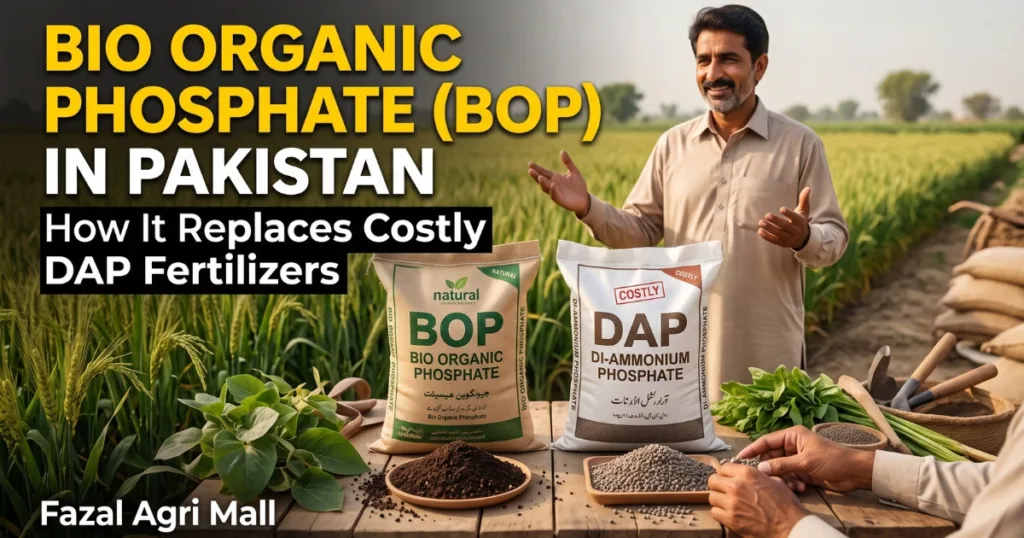
Bio Organic Phosphate (BOP) in Pakistan: How It Replaces Costly DAP Fertilizers
Table of Contents
Agriculture is the backbone of Pakistan’s economy, but rising fertilizer costs are putting increasing pressure on farmers. From wheat and rice to maize, vegetables and cotton, maintaining soil fertility is essential for healthy crop growth and better yields. Among the major expenses, phosphate fertilizers such as DAP (Diammonium Phosphate) play an important role in providing phosphorus to crops.
As farmers search for more affordable and sustainable options, Bio Organic Phosphate (BOP) in Pakistan is gaining attention as a potential alternative or supplement to conventional phosphate fertilizers. But can BOP really replace costly DAP fertilizers? Understanding how it works, its benefits and its limitations can help farmers make informed decisions.
In this guide, we explore BOP fertilizer, its potential advantages and how Pakistani farmers can use it as part of an effective crop nutrition strategy.
What Is Bio Organic Phosphate (BOP)?
Bio Organic Phosphate (BOP) is a category of phosphate-based agricultural products that may combine organic materials, phosphorus sources and beneficial microorganisms, depending on the formulation. Certain microbial products are designed to improve the availability of phosphorus already present in the soil, making it easier for plants to absorb this essential nutrient.
Unlike conventional DAP fertilizer, which supplies concentrated nitrogen and phosphorus in a readily available form, some BOP formulations focus on supporting nutrient cycling and improving the efficiency of phosphorus use.
However, BOP products are not all identical. Their nutrient content, microbial strains, quality and recommended application rates can vary significantly. Farmers should check the product label and guaranteed analysis before making a purchase.
Why Is DAP Fertilizer Expensive for Pakistani Farmers?
DAP is widely used in Pakistan because it supplies two important plant nutrients:
- Nitrogen: Supports vegetative growth and the development of leaves and stems.
- Phosphorus: Supports root development, energy transfer, flowering and early crop establishment.
Despite these benefits, the cost of DAP can make crop production more expensive, especially when farmers cultivate large areas or grow crops with substantial fertilizer requirements.
Several factors can affect fertilizer prices, including international raw material costs, energy prices, transportation, currency fluctuations and local supply and demand.
When input costs rise, farmers need to improve fertilizer efficiency without compromising crop nutrition. This is where alternative phosphate products, including suitable BOP formulations, may deserve consideration.
How Can BOP Help Reduce Dependence on Costly DAP Fertilizers?
Bio Organic Phosphate may help reduce dependence on conventional phosphate fertilizer under suitable soil and crop conditions. However, the extent of any savings depends on the product’s actual nutrient content, soil phosphorus levels and crop requirements.
Improving Phosphorus Availability
Some phosphate-solubilizing microorganisms can help convert certain forms of soil-bound phosphorus into forms that plants can absorb. This process may improve phosphorus availability when the soil contains suitable phosphorus reserves.
It is important to understand that these microorganisms do not create phosphorus from nothing. If the soil lacks sufficient phosphorus, an additional phosphorus source may still be necessary.
Supporting Healthy Root Development
Phosphorus is essential for root growth, particularly during the early stages of crop development. Adequate phosphorus nutrition helps crops establish stronger root systems, which can support water and nutrient uptake.
When a BOP product effectively improves phosphorus availability, it may contribute to better early crop establishment as part of a balanced fertilization program.
Supporting More Efficient Fertilizer Use
Farmers sometimes apply fertilizers without testing their soil or calculating crop nutrient requirements. This can result in unnecessary expenses or nutrient deficiencies.
A suitable BOP product, used according to its verified nutrient content and recommendations, may complement a fertilizer management plan and improve phosphorus-use efficiency. Actual benefits should be evaluated through field trials.
Potentially Lowering Fertilizer Expenses
BOP may offer cost-saving opportunities when it allows farmers to reduce unnecessary phosphate applications without reducing crop performance. Nevertheless, replacing a portion of DAP is not automatically economical.
Farmers should compare the total cost per acre, nutrient contribution, application requirements and resulting crop yield before deciding whether BOP is a financially attractive option.
BOP vs DAP Fertilizer: What Is the Difference?
Understanding the difference between BOP and DAP helps farmers choose an appropriate fertilizer strategy.
| Feature | Bio Organic Phosphate (BOP) | DAP Fertilizer |
| Main purpose | May improve phosphorus availability or supply phosphorus, depending on formulation | Supplies concentrated nitrogen and phosphorus |
| Nutrient content | Varies by product | Standard DAP commonly contains 18% nitrogen and 46% phosphate expressed as P₂O₅ |
| Mode of action | May involve organic components or beneficial microorganisms | Supplies mineral nutrients directly |
| Soil dependence | Benefits can depend on soil conditions and microbial activity | Phosphorus availability depends on soil chemistry and placement |
| Replacement potential | Depends on nutrient analysis and field performance | Provides a known nutrient contribution when properly labelled |
| Cost-saving potential | Must be verified through local cost and yield comparisons | Depends on price, crop requirements and application efficiency |
BOP should not be assumed to provide the same amount of phosphorus or nitrogen as DAP. A product with little or no guaranteed phosphorus content cannot replace DAP’s phosphorus contribution on a one-to-one basis.
Which Crops in Pakistan May Benefit from BOP?
The suitability of BOP depends on the specific formulation, soil conditions and crop nutrient requirements. Farmers growing the following crops may investigate appropriate phosphate-management options.
Wheat
Wheat requires sufficient phosphorus for early root development, tillering and crop establishment. A suitable phosphate-management plan can help support healthy growth, especially in phosphorus-deficient soils.
Rice
Rice requires balanced nutrition throughout its growth cycle. Phosphorus management should consider soil conditions, water management and the crop’s overall fertilizer needs.
Maize
Maize benefits from adequate phosphorus during early development. Farmers should ensure that the selected fertilizer program supplies enough available phosphorus to support strong establishment.
Cotton
Cotton requires balanced nutrient management for healthy root growth, flowering and boll development. Phosphate products should be selected according to soil tests and the crop’s nutrient requirements.
Vegetables
Vegetable crops can have different phosphorus requirements depending on the species, growing season and production system. Farmers should choose products suitable for the particular vegetable and follow the manufacturer’s instructions.
How to Use BOP Fertilizer Effectively
To get the best possible results from Bio Organic Phosphate, farmers should follow a practical, evidence-based approach.
Test Your Soil
A soil test helps determine the amount of available phosphorus, soil pH and other important nutrient levels. This information helps identify whether the farm needs additional phosphorus or could benefit from improved nutrient availability.
Check the Product’s Nutrient Analysis
Before purchasing BOP, review its guaranteed phosphorus content organic components, microbial strains where applicable, expiry date and application instructions. Choose a product with reliable quality information.
Follow the Recommended Application Rate
Apply BOP according to the manufacturer’s directions and the advice of a qualified agricultural professional. Do not assume that the recommended rate for one brand or formulation applies to another.
Compare BOP and DAP in Field Trials
If you are considering replacing part of your DAP application, compare the recommended fertilizer program with a BOP-based treatment on a small, representative area. Keep other farming practices as consistent as possible.
Measure crop growth, yield, fertilizer expenses and the overall return per acre before expanding the practice.
Maintain Balanced Crop Nutrition
Plants require nitrogen, phosphorus, potassium and several secondary and micronutrients. BOP should be part of a balanced nutrient plan rather than a substitute for every fertilizer.
Can BOP Completely Replace DAP Fertilizer?
DAP supplies a concentrated amount of nitrogen and phosphorus, whereas BOP products can differ in their nutrient content and mode of action. A microbial product that improves phosphorus availability may not supply enough new phosphorus to meet a crop’s entire requirement.
Complete replacement may only be considered when the product’s verified nutrient contribution, existing soil phosphorus and field-trial results demonstrate that the crop receives adequate nutrition without an unacceptable yield reduction.
For many farmers, the more practical approach is to evaluate BOP as a potential supplement or partial replacement, rather than eliminating DAP immediately.
How to Calculate Whether BOP Saves Money
A lower purchase price does not always mean a lower cost of crop production. Farmers should compare the cost of the complete fertilizer program.
For example, calculate:
- The cost of DAP required per acre.
- The cost of the proposed BOP application per acre.
- The cost of any additional fertilizer needed to balance nutrients.
- Application and transport expenses.
- Crop yield and market value under each treatment.
The most useful comparison is the net return per acre, not simply the price of one fertilizer bag.
Farmers should also consider the risk of yield loss if an alternative product does not provide adequate phosphorus. A small field trial can help reduce this risk before changing the fertilizer program across the whole farm.
Where Can Farmers Find Agricultural Products in Pakistan?
Choosing reliable agricultural inputs is an important part of successful farming. Farmers should purchase fertilizers and soil-improvement products from reputable suppliers, check product labelling and verify that products meet applicable registration and quality requirements.
Fazalagrimall aims to help farmers explore agricultural products and make more informed purchasing decisions. Before choosing a BOP product, compare its specifications, recommended uses, price and suitability for your crop and soil conditions.
For fertilizer recommendations, consult a qualified local agronomist or soil-testing laboratory to develop a nutrient plan suited to your farm.
Frequently Asked Questions (FAQs)
1. What is Bio Organic Phosphate (BOP)?
Bio Organic Phosphate is a term used for phosphate-related agricultural products that may contain organic materials, phosphorus sources or beneficial microorganisms. The exact composition and benefits depend on the individual product.
2. Can BOP replace DAP fertilizer in Pakistan?
BOP may replace part of a DAP application in suitable conditions, but complete replacement should not be assumed. The decision depends on the product’s nutrient analysis, soil-test results, crop requirements and field performance.
3. Is BOP fertilizer suitable for wheat and rice?
Some BOP formulations may be suitable for wheat and rice, provided their labels support those uses. Farmers should follow recommended application instructions and ensure that the crops receive sufficient phosphorus and other essential nutrients.
4. Does BOP improve soil fertility?
Certain BOP products may support nutrient availability or soil biological activity. However, their effects depend on the formulation and soil conditions. Long-term soil fertility also requires balanced nutrient management and good agricultural practices.
5. How can farmers compare BOP and DAP prices?
Compare the total cost per acre, the amount of available phosphorus supplied, any additional nutrients required and the resulting crop yield. The cheapest bag is not necessarily the most economical option.
6. Where can farmers buy BOP fertilizer in Pakistan?
Farmers should look for reputable agricultural suppliers, verify the product’s composition and quality and confirm that it is suitable for the intended crop. They can also explore agricultural products through Fazalagrimall and seek professional advice before changing their fertilizer program.
Final Thought
Bio Organic Phosphate offers an option worth investigating for farmers seeking better phosphorus management and more efficient fertilizer use in Pakistan. However, the right choice depends on soil conditions, crop requirements, product quality and the actual cost per acre.
Rather than replacing DAP without evidence, farmers should use soil testing, verified product information and small-scale field trials to determine whether BOP can reduce fertilizer expenses while maintaining crop yields.
With informed decisions and balanced crop nutrition, farmers can work toward more economical and sustainable agriculture. Fazalagrimall encourages farmers to choose agricultural inputs carefully and build a fertilizer strategy around their soil’s real needs.
For expert guidance on choosing the right NPK fertilizer for your crops, contact Fazal Agri Mall today and explore quality agricultural products to support healthier growth and better farming results.



No Comments