
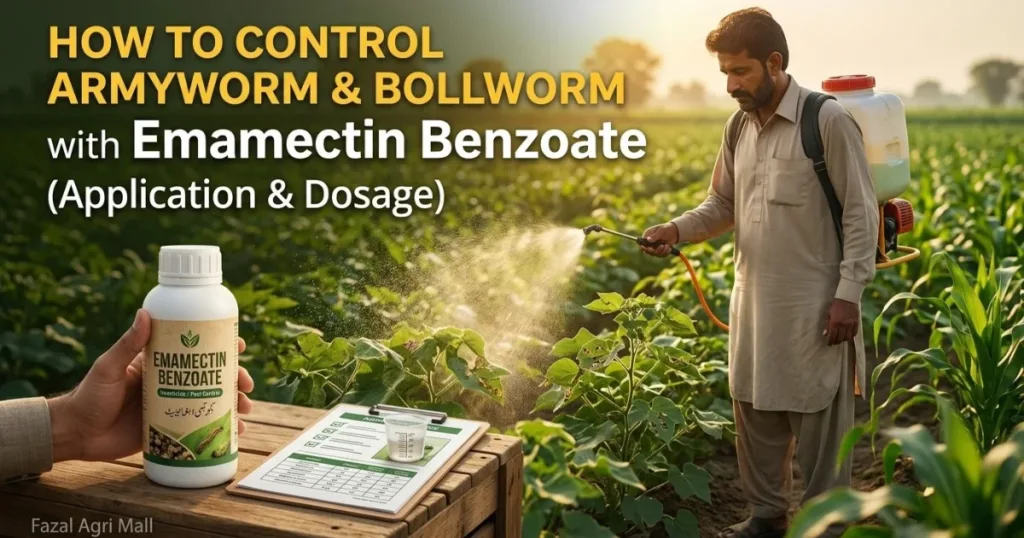
How to Control Armyworm & Bollworm with Emamectin Benzoate (Application & Dosage)
Table of Contents
Armyworm and bollworm infestations can seriously damage cotton, maize, vegetables and other crops if they are not managed at the right time. These destructive pests feed on leaves, flower buds, fruits and developing crop parts, reducing crop quality and potentially lowering yields.
Emamectin Benzoate is an insecticide used to control several caterpillar pests when applied according to the product label. For farmers in Pakistan, understanding the correct application method, dosage and timing can help improve pest management and protect crop productivity.
In this guide, fazalagrimall explains how Emamectin Benzoate works, how to apply it responsibly and which precautions farmers should follow for effective armyworm and bollworm control.
What Is Emamectin Benzoate?
Emamectin Benzoate is an insecticide belonging to the avermectin group. It acts primarily through ingestion, affecting the nervous system of susceptible insect larvae and causing feeding to stop before the insects eventually die.
It is used against various caterpillar pests, including certain armyworms, bollworms and fruit borers, depending on the formulation and registered crop uses.
Farmers should remember that different products can contain different concentrations and formulations, such as EC and SG. Therefore, the recommended dose for one product cannot automatically be applied to another.
Common Signs of Armyworm and Bollworm Attacks
Before choosing an insecticide, inspect your crops carefully to identify the pest and assess the extent of damage.
Armyworm infestation
Armyworms commonly feed on leaves and tender plant tissues. Depending on the species and crop, symptoms may include:
- Irregular holes in leaves.
- Damaged leaf edges and skeletonized foliage.
- Caterpillars hiding in leaf folds or maize whorls.
- Dark insect droppings around damaged areas.
- Rapidly increasing damage when larvae are numerous.
Fall armyworm is particularly important in maize, where young larvae feed inside the central whorl.
Bollworm infestation
Bollworms attack reproductive parts of crops, especially cotton and various vegetables. Common symptoms include:
- Holes in cotton squares, flowers and bolls.
- Damaged buds and shedding of reproductive parts.
- Caterpillars feeding inside fruit or pods.
- Holes in tomato fruits and other susceptible vegetables.
- Visible feeding damage on young plant tissues.
Correct identification matters because not every caterpillar responds equally to the same insecticide.
How Does Emamectin Benzoate Control Armyworm and Bollworm?
Emamectin Benzoate interferes with nerve signal transmission in susceptible insect larvae. After exposure, larvae become less active, stop feeding and eventually die.
Its effectiveness depends on several factors:
- Correct pest identification: Confirm that the target pest is listed on the product label.
- Early treatment: Young larvae are generally easier to control than large, mature caterpillars.
- Proper coverage: Spray must reach the areas where larvae feed.
- Correct dosage: Follow the instructions for the specific formulation and crop.
- Resistance management: Repeated use of the same insecticide mode of action can reduce effectiveness over time.
For better results, combine insecticide use with regular field monitoring and other suitable integrated pest management practices.
Emamectin Benzoate Application and Dosage
The correct Emamectin Benzoate dosage depends on the product’s concentration, formulation, crop, target pest and registered instructions.
Application guidelines
- Identify the crop and pest: Check whether the product is registered for your crop and the specific insect.
- Read the product label: Confirm the concentration, dose per acre, water volume, application method and harvest waiting period.
- Calibrate your sprayer: Ensure that the equipment distributes the required spray volume evenly over the intended area.
- Apply with appropriate coverage: Direct the spray towards infested leaves, cotton reproductive parts, or maize whorls, as appropriate for the target pest and label directions.
- Choose suitable weather: Avoid spraying in strong winds or when rain is likely to wash off the product. Follow the label’s weather restrictions.
- Inspect the field again: Assess pest activity after the interval recommended by the product instructions before deciding whether another treatment is necessary.
Important: Do not increase the dose to compensate for poor coverage or an ineffective treatment. If control is inadequate, seek advice from a qualified agricultural professional.
Best Time to Apply Emamectin Benzoate
Application timing can significantly influence pest control.
For armyworm in maize
Inspect maize regularly for fresh feeding damage, especially in the central whorl. When treatment is justified, ensure that the spray reaches the feeding area and follows the product’s registered directions.
For bollworm in cotton
Monitor cotton squares, flowers and bolls for fresh damage and live larvae. Timely treatment against susceptible, young larvae can improve control compared with waiting until extensive damage has occurred.
For fruit borers in vegetables
Inspect leaves, flowers and fruits for eggs, young caterpillars and feeding damage. Use only a product registered for the particular vegetable and pest and observe its pre-harvest interval.
Do not spray automatically on a fixed schedule. Base treatment decisions on field scouting, pest pressure, crop stage and local agricultural recommendations.
Safety Precautions When Using Emamectin Benzoate
Responsible pesticide use protects farmers, consumers, beneficial insects and the environment.
- Wear the protective equipment specified on the product label.
- Keep children and animals away from mixing and spraying areas.
- Avoid inhaling spray mist or allowing the product to contact skin and eyes.
- Never use food or drink containers to measure or store pesticides.
- Do not mix Emamectin Benzoate with other pesticides unless the label permits the combination.
- Protect bees and other beneficial insects by following label restrictions, particularly during flowering.
- Observe the pre-harvest interval before picking or selling treated crops.
- Follow the product’s re-entry interval before allowing workers back into treated fields.
- Dispose of empty containers according to local regulations; never reuse them for household purposes.
How to Prevent Insecticide Resistance
Repeated applications of the same insecticide can encourage resistant pest populations. To maintain effective pest control:
- Rotate insecticides with different modes of action when recommended by an agricultural professional.
- Avoid unnecessary applications and excessive doses.
- Remove heavily infested crop residues when appropriate.
- Monitor crops frequently and record pest levels and treatment outcomes.
- Use biological, cultural and other integrated pest management methods where suitable.
A balanced pest management plan is gener
Frequently Asked Questions (FAQs)
1. What is Emamectin Benzoate used for?
Emamectin Benzoate is used to manage certain caterpillar pests, including susceptible armyworms, bollworms and fruit borers, when the product is registered for the crop and target pest.
2. What is the correct Emamectin Benzoate dosage per acre?
There is no single dose for every product. The recommended amount depends on its concentration, formulation, crop and target pest. Follow the exact product label and local agricultural guidance.
3. Is Emamectin Benzoate effective against armyworm in maize?
Certain registered formulations can control fall armyworm in maize. Correct timing, coverage of the feeding area and compliance with the product label are important.
4. Can Emamectin Benzoate control bollworm in cotton?
Yes, some registered formulations are recommended for specified cotton bollworm species. Confirm the target pest and cotton use on the exact product label before application.
5. When should I spray Emamectin Benzoate?
Treatment is generally most useful when susceptible larvae are young and active, provided monitoring indicates that treatment is warranted. Follow crop-specific recommendations and the label’s application instructions.
6. Is Emamectin Benzoate safe for crops?
When used on a registered crop at the labelled rate and under the required conditions, it is intended for that approved use. Incorrect application, excessive doses, or unsuitable mixtures can cause problems. Follow all label precautions and harvest restrictions.
Final Thought
Controlling armyworm and bollworm requires early identification, regular field scouting, correct insecticide selection and careful application. Emamectin Benzoate can be a useful part of a pest management program when the formulation is appropriate for the crop and target insect.
For farmers seeking reliable agricultural information and crop protection products, fazalagrimall aims to support smarter farming decisions. Always verify the product label and consult a qualified agricultural expert before treating your crop.
Protect your crops with informed decisions, responsible pesticide use and consistent field monitoring.
Contact fazalagrimall today for agricultural products and guidance to help you manage armyworm and bollworm infestations and protect your crops.



No Comments