
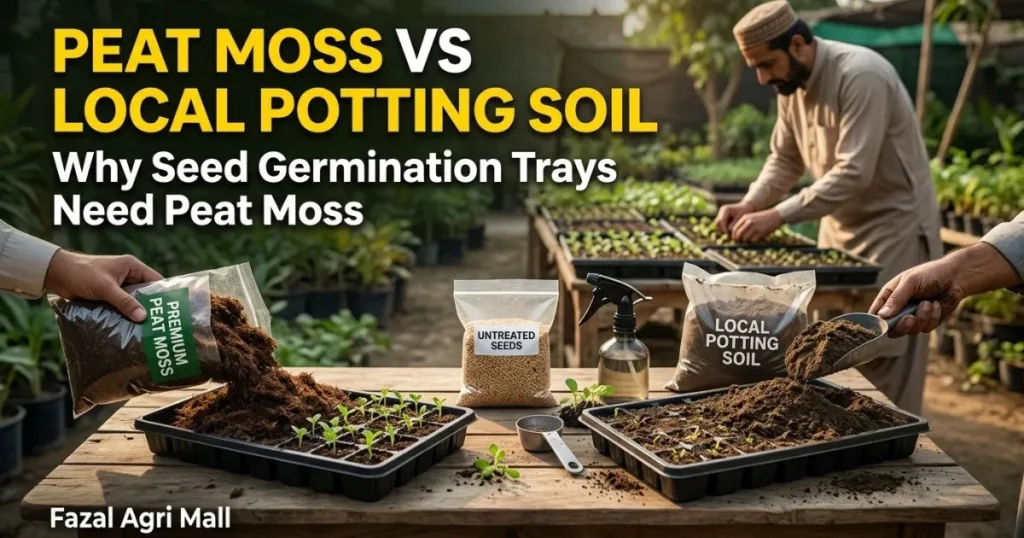
Peat Moss vs Local Potting Soil: Why Seed Germination Trays Need Peat Moss
Table of Contents
Introduction
Every healthy plant begins with a tiny seed, but the growing medium you choose can make a significant difference in its early development. Whether you are growing vegetables in your home garden or producing seedlings for a commercial nursery, choosing the right material for seed germination trays is essential.
Many farmers and gardeners in Pakistan use local garden soil or homemade potting mixtures because they are affordable and readily available. However, these materials may become compacted, retain excess water or contain unwanted weed seeds and disease-causing organisms. These problems can make it difficult for delicate seedlings to develop strong roots.
This is where peat moss comes in. Its lightweight structure, moisture-retention capacity and ability to provide air around developing roots make it a popular ingredient in seed-starting mixes.
In this guide, we will explore peat moss vs local potting soil, explain why peat-based seed-starting mixes are often preferred and share practical tips for achieving healthier seedlings with FazalAgriMall.
What Is Peat Moss?
Peat moss is an organic material formed from partially decomposed plant matter, commonly sphagnum moss, in waterlogged environments. Horticultural-grade peat moss is widely used in seed-starting mixes, nursery production and container gardening.
Unlike ordinary garden soil, peat moss is lightweight and fibrous. When properly moistened and blended with suitable materials, it can hold water while maintaining air spaces that developing roots need.
Key Benefits of Peat Moss
- Excellent moisture retention: Helps keep seeds and young roots consistently moist.
- Improved root aeration: Supports healthy root development when used in a well-structured mix.
- Lightweight texture: Makes seed trays easier to handle and transport.
- Low weed-seed content: Quality horticultural peat products generally contain fewer weed seeds than untreated garden soil.
- Uniform growing conditions: Helps create a consistent environment across multiple seedling cells.
- Easy blending: Can be combined with perlite, vermiculite or other suitable ingredients.
Keep in mind that pure peat moss is naturally acidic and contains very few nutrients. It should be prepared appropriately for the crop and growing system rather than treated as a complete growing medium.
What Is Local Potting Soil?
Local potting soil usually refers to soil collected from fields, gardens or nearby sources and sometimes mixed with compost, sand, manure or other materials.
Its quality depends on where it comes from and how it is prepared. A properly screened and treated soil-based mixture can support plant growth, but untreated local soil is often less predictable than a professionally formulated seed-starting mix.
Common Problems With Local Soil in Seed Trays
Heavy texture
Clay-rich soil can become dense, limiting the movement of air and water around young roots.
Poor drainage
When water remains trapped in small seedling cells, roots may receive insufficient oxygen, increasing the risk of root damage.
Weed seeds
Untreated soil may introduce unwanted plants that compete with seedlings for water, light and nutrients.
Soilborne diseases
Some local soils contain pathogens that can cause damping-off, a disease that makes young seedlings collapse near the soil surface.
Uneven results
Soil taken from different locations may vary in texture, nutrient content, salinity and pH. This variation can lead to inconsistent seedling growth.
For these reasons, untreated local soil is generally not the first choice for professional seed germination trays.
Peat Moss vs Local Potting Soil: Key Differences
Understanding the differences between these growing materials helps you choose the right option for your nursery or garden.
| Feature | Peat Moss-Based Seed Mix | Untreated Local Soil |
| Texture | Lightweight and fibrous | Often heavy or compact |
| Moisture retention | High when properly prepared | Varies with soil type |
| Drainage | Good when blended appropriately | Can be poor in clay-rich soil |
| Aeration | Generally good in a suitable mix | May decrease with compaction |
| Weed seeds | Usually low in quality products | May contain weed seeds |
| Disease risk | Generally lower in quality, clean mixes | May contain harmful pathogens |
| Nutrient content | Usually low in pure peat | Varies by source |
| Consistency | More predictable when quality controlled | Can vary considerably |
| Best use | Seed starting and nursery trays | Field cultivation and suitable soil-based mixes |
The important distinction is that peat moss is not automatically better than every potting soil. A high-quality, well-formulated potting mix can perform just as well. The main advantage is choosing a growing medium designed for the specific needs of germinating seeds.
Why Seed Germination Trays Need Peat Moss
Seed germination trays contain small cells with limited space for roots, water and air. This makes the growing medium especially important.
Here are the main reasons peat moss-based mixes are popular for seed starting.
Better Moisture Management
Seeds require adequate moisture to begin germination. If the growing medium dries out, germination may be delayed or interrupted. If it remains waterlogged, oxygen becomes limited.
Peat moss holds substantial moisture while a properly formulated mix allows excess water to drain. This balance supports a more stable environment for germinating seeds.
Before using peat moss, moisten it thoroughly. Dry peat can initially repel water, causing water to run off rather than soak into the material.
Stronger Early Root Development
Newly emerging roots are delicate and need room to spread. A loose, airy growing medium allows roots to explore the available space without struggling against dense, compacted soil.
When peat moss is blended with a suitable aeration material, such as perlite or vermiculite, it can help create favorable conditions for root development.
More Uniform Seedling Growth
Commercial nurseries often need hundreds or thousands of seedlings to grow at a similar rate.
A consistent seed-starting mix helps provide more uniform moisture, texture and root-zone conditions across the tray. This makes irrigation and seedling management easier.
Uniform growth is particularly useful when raising tomato, chilli, capsicum, cucumber, cabbage and other vegetable seedlings.
Lower Risk of Soilborne Problems
Untreated garden soil may contain disease-causing organisms, insects and weed seeds. These can be especially problematic in crowded seed trays.
Quality peat moss-based growing media are generally low in weed seeds and are often produced under controlled conditions. However, peat moss is not a guarantee against disease. Clean trays, safe water, proper airflow and careful watering are also essential.
Easier Handling and Transplanting
Peat-based mixes are generally lighter than mineral soil. This makes trays easier to move around a nursery, greenhouse or home garden.
When seedlings develop a healthy root system in a suitable mix, they can also be easier to remove from individual cells for transplanting.
How to Prepare Peat Moss for Seed Germination Trays
You do not need expensive equipment to prepare a suitable seed-starting medium. Follow these steps to create a practical growing mix.
Choose Quality Peat Moss
Purchase horticultural-grade peat moss from a reliable supplier. Avoid materials that contain large pieces of debris or have an unknown composition.
If peat moss is unavailable or unsuitable for your budget, consider a quality coco peat-based seed-starting mix.
Blend With an Aeration Material
A simple starting recipe is:
- 2 parts horticultural peat moss
- 1 part perlite or fine vermiculite
Measure the ingredients by volume and mix them thoroughly.
This is a general-purpose starting point, not a universal formula. Adjust the blend according to the crop, tray size, local climate and watering method. Pure peat moss is also not a complete nutrient source.
Moisten the Mixture
Add water gradually and mix until the material is evenly moist, similar to a wrung-out sponge.
Avoid making the mix soggy. Excess water reduces air availability around the seeds and roots.
Fill the Germination Trays
Use clean trays with suitable drainage holes. Fill each cell loosely, then level the surface.
Do not compress the growing medium too firmly because compaction can reduce aeration.
Sow the Seeds Correctly
Plant seeds according to the instructions for the particular crop. Some seeds require light to germinate, while others need to be covered with a thin layer of growing medium.
Use fresh, suitable-quality seeds and label each tray with the crop name and sowing date.
Maintain the Right Moisture and Temperature
Keep the growing medium consistently moist but not waterlogged. Follow crop-specific temperature requirements and provide adequate light after seedlings emerge.
Avoid excessive watering and stagnant air, which can encourage fungal problems.
Feed Seedlings When Necessary
Pure peat moss contains very few nutrients. Some commercial seed-starting mixes include a starter fertilizer, while others do not.
Check the product label and begin feeding with a suitable, diluted seedling fertilizer when necessary. Avoid excessive fertilizer because young roots can be sensitive to high salt concentrations.
Is Peat Moss Better Than Local Soil for Vegetable Seeds in Pakistan?
For many vegetable crops, a quality peat-based seed-starting mix is a practical choice for nursery trays in Pakistan.
Tomato, chilli, capsicum, cabbage, cauliflower, cucumber and brinjal are examples of crops commonly raised as seedlings before transplanting. Their early development can benefit from a growing medium that provides consistent moisture, good aeration and a low risk of contamination.
However, Pakistan’s growing conditions vary considerably. High temperatures, low humidity, water quality and the quality of locally available materials can all affect seedling performance.
For best results:
- Use clean, well-drained seed trays.
- Protect seedlings from extreme heat and direct midday sun when necessary.
- Monitor moisture more frequently during hot weather.
- Check irrigation water quality, particularly where salinity is a concern.
- Harden seedlings gradually before transplanting them into the field.
- Compare the cost and performance of peat moss with locally available coco peat and quality commercial mixes.
Practical tip: If peat moss is expensive or difficult to source, coco peat can be a useful alternative. It should be properly washed or buffered when needed, particularly if its salt content is unknown. A suitable coco peat-based mix can also support healthy seed germination.
Peat Moss vs Coco Peat: Which Is Better?
Although peat moss and coco peat are both used in seed-starting mixes, they come from different sources.
Peat moss is harvested from peatlands, where organic matter accumulates over long periods. Coco peat is produced from coconut husks, a by-product of the coconut industry.
Peat moss is known for its moisture retention and fibrous structure. Coco peat can also retain moisture while providing a useful growing structure, although its quality and salt content vary between products.
For farmers and gardeners in Pakistan, the best choice depends on availability, cost, product quality, crop requirements and environmental considerations.
Peat extraction can damage peatland ecosystems and release stored carbon. Where practical, a reliable peat-free alternative may be worth considering, especially if it performs well in local conditions.
Common Mistakes to Avoid When Using Peat Moss
Even a high-quality growing medium cannot compensate for poor seedling care. Avoid these common mistakes:
- Using completely dry peat moss: It may be difficult to wet evenly.
- Overwatering trays: Excess moisture can restrict oxygen and encourage damping-off.
- Using pure peat without considering pH: Its natural acidity may not suit every crop.
- Ignoring nutrients: Seedlings may eventually require additional feeding.
- Compressing the mixture: Dense growing media can restrict air movement.
- Reusing dirty trays: Old plant material may carry disease organisms.
- Choosing poor-quality ingredients: Salty coco peat or contaminated compost can harm young seedlings.
- Transplanting too late: Overgrown seedlings may become root-bound or stressed.
A little preparation and consistent monitoring can make a substantial difference to seedling health.
Frequently Asked Questions (FAQs)
1. Is peat moss better than local soil for seed germination?
A quality peat moss-based seed-starting mix is often better than untreated local soil because it is lightweight, retains moisture and provides better aeration when properly formulated. However, a high-quality soil-based mix can also work well.
2. Can I use pure peat moss in seed germination trays?
Pure peat moss can be used for certain seed-starting applications, but it has little nutritional value and is naturally acidic. A suitable blend with an aeration material and appropriate pH management is often more practical for raising seedlings.
3. What is the best mixture for seed germination trays?
A simple starting recipe is two parts horticultural peat moss and one part perlite or fine vermiculite by volume. Adjust it according to crop requirements, moisture conditions and the quality of the ingredients.
4. Can I use coco peat instead of peat moss?
Yes. Quality coco peat can be an effective alternative for seed starting. Check its salt content and ensure that the material is suitable for horticultural use.
5. Why are my seeds not germinating in peat moss?
Possible reasons include old seeds, incorrect sowing depth, unsuitable temperatures, poor moisture management, excessive salts or an inappropriate pH. Check the seed packet instructions and the quality of your growing medium.
6. Where can I buy agricultural and gardening supplies in Pakistan?
You can explore FazalAgriMall for agricultural and gardening supplies. Before purchasing any growing medium, check the product specifications, intended use and suitability for your crop.
Final Thought
The comparison between peat moss and local potting soil comes down to consistency, moisture management, aeration and cleanliness. For seed germination trays, a quality peat moss-based mix often provides a more predictable starting environment than untreated garden soil.
Nevertheless, peat moss is not the only solution. Coco peat and other well-formulated seed-starting media can also deliver excellent results when their quality and growing requirements are properly managed.
Whether you are a home gardener, a smallholder farmer or a commercial nursery owner, investing in a suitable growing medium can help you raise healthier seedlings and improve transplanting success.
For high-quality peat moss, seed germination supplies and reliable agricultural products, contact FazalAgriMall today and give your seeds the best start for healthy growth and better results!
No Comments