
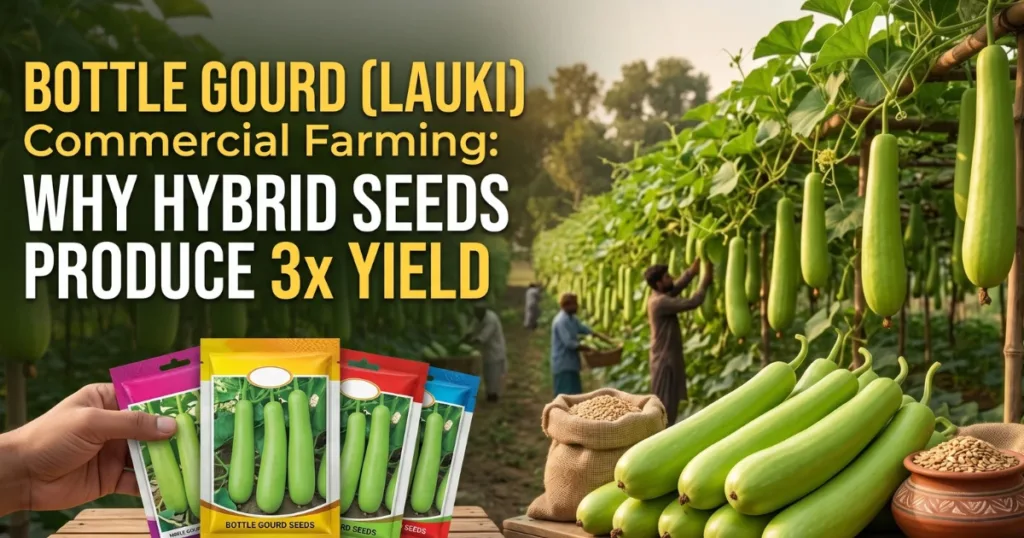
Bottle Gourd Farming: Why Hybrid Seeds Produce 3x Yield
Table of Contents
Bottle gourd, commonly known as lauki (لوکی) in Pakistan, is an important summer vegetable with strong potential for commercial farming. From small-scale growers to large agricultural businesses, farmers can improve crop productivity by selecting suitable seeds, preparing fertile soil, managing irrigation and controlling pests at the right time.
Bottle gourd commercial farming can be a profitable opportunity when farmers combine good agricultural practices with high-quality hybrid seeds. Hybrid varieties are often developed for improved yield potential, uniform fruit size, vigorous plant growth and better market appeal. However, actual production depends on the variety, climate, soil fertility, water availability and crop management.
In this guide, we explain how to grow bottle gourd commercially, choose the right hybrid seeds, improve fruit production and manage your crop for better returns. With the right planning and quality agricultural inputs from fazalagrimall, farmers can take practical steps toward a healthier and more productive lauki crop.
Why Hybrid Seeds Matter in Bottle Gourd Farming
Choosing the right seed is one of the most important decisions in commercial vegetable production. Traditional and open-pollinated varieties can perform well under suitable conditions, but quality hybrid seeds may offer useful advantages for farmers who want consistent production and marketable fruit.
Higher Yield Potential
Hybrid bottle gourd farming seeds may produce vigorous plants with more productive branches and improved fruit-setting potential. Under suitable growing conditions, some hybrids can outperform conventional varieties. However, a threefold (3x) yield increase is not guaranteed and should only be claimed when supported by reliable trial data for the specific varieties and growing conditions.
Uniform Fruit Size and Shape
Buyers and vegetable wholesalers often prefer bottle gourds with consistent size, attractive green skin and good shape. Depending on the variety, hybrid plants may produce more uniform fruits, helping farmers prepare their harvest for local markets.
Improved Crop Vigour
Suitable hybrid varieties can establish strong plants when grown in well-prepared soil with appropriate nutrition and irrigation. Healthy vines help support flowering and fruit development throughout the productive period.
Better Commercial Market Potential
Uniform, fresh-looking bottle gourds can be easier to grade, pack and sell. Farmers should select varieties according to local buyer preferences, expected fruit size, transport requirements and the duration of the growing season.
More Efficient Farm Planning
Using a suitable hybrid variety with a known maturity period can help farmers plan sowing, crop care, labour, harvesting and market deliveries more effectively.
Best Season for Bottle Gourd Farming in Pakistan
The right sowing time helps bottle gourd plants establish healthy vines, produce flowers and develop marketable fruits. In Punjab, bottle gourd farming seeds is commonly grown in spring and summer, with sowing windows varying according to local temperatures and the variety selected.
According to Punjab Agricultural University’s cultivation guidance, common sowing windows include February–March and June–July. Protected cultivation may allow additional seasonal options in suitable areas.
For farmers in Punjab, consider these practical guidelines:
- Spring crop: Prepare for sowing during February and March when soil and weather conditions are suitable.
- Summer crop: June and July can provide another planting opportunity where irrigation and heat management are adequate.
- Protected cultivation: Consider this only after checking local temperature, ventilation and variety requirements.
Avoid sowing in cold or frost-prone conditions. Check the recommended sowing season printed on your selected seed packet and adjust it to your district’s climate.
How to Prepare Land for Bottle Gourd Farming
Proper field preparation improves root development, water movement and nutrient availability. Bottle gourd farming grows well in fertile, well-drained loam or sandy loam soil rich in organic matter.
Follow these steps before planting:
- Plough the field: Break large soil clods and prepare a fine, workable seedbed.
- Improve soil fertility: Incorporate well-decomposed farmyard manure or compost according to soil conditions.
- Ensure drainage: Prevent waterlogging around the roots, particularly in heavy soils.
- Prepare beds or ridges: Use a layout that allows efficient irrigation and easy movement between crop rows.
- Check soil condition: A soil test can help determine which nutrients are required and prevent unnecessary fertilizer applications.
Healthy soil supports steady vine growth and helps plants use water and nutrients more efficiently.
Bottle Gourd Farming Seed Rate and Plant Spacing
Correct spacing gives vines enough room to grow and allows sunlight and air to reach the foliage. Overcrowded plants can be difficult to manage and may experience greater disease pressure.
Punjab Agricultural University guidance lists approximately 2 kg of seed per acre and bed widths of 2–2.5 metres, with plants spaced 45–60 cm apart for the described cultivation system. Requirements can vary with the variety and planting method.
For commercial planting:
- Confirm the seed rate recommended for your specific hybrid.
- Follow the variety’s instructions for row spacing and plant spacing.
- Avoid planting extra seeds simply to compensate for poor-quality seed.
- Keep irrigation channels accessible for crop maintenance.
- Thin seedlings where necessary to maintain the planned spacing.
Always follow the seed supplier’s instructions because different hybrids may have different growth habits and recommended planting arrangements.
Irrigation and Fertilizer Management for Higher Yield
Hybrid seeds alone cannot guarantee high production. Proper irrigation and balanced nutrition are equally important for flowering, fruit development and continued harvesting.
Irrigation Management
Keep the root zone consistently moist without saturating the soil. Bottle gourd needs an appropriate water supply during vine development, flowering and fruit enlargement.
- Irrigate according to soil moisture and weather conditions.
- Increase monitoring during hot, dry weather.
- Avoid prolonged waterlogging and poor drainage.
- Use drip irrigation where practical to improve water management.
- Reduce unnecessary wetting of foliage to help manage disease risk.
Fertilizer Management
A balanced fertilizer plan supports healthy roots, vines, flowers and fruits. The correct quantities depend on soil fertility, crop history, irrigation and expected production.
Consider these practices:
- Apply well-decomposed organic manure before planting where appropriate.
- Use soil-test results to guide nitrogen, phosphorus and potassium applications.
- Apply nitrogen in suitable splits instead of excessive doses at once.
- Maintain adequate potassium for fruit development.
- Avoid excessive nitrogen, which can encourage leafy growth at the expense of balanced fruit production.
For commercial fields, consult a local agricultural extension officer or qualified agronomist to develop a fertilizer schedule for your soil and selected hybrid.
Pest and Disease Management in Bottle Gourd
Pests and diseases can reduce marketable yield even when farmers use high-quality seeds. Regular field inspection allows growers to identify problems before they spread widely.
Common issues include:
- Aphids: These insects feed on plant sap and can transmit certain plant viruses.
- Whiteflies: They weaken plants and may contribute to virus transmission.
- Fruit flies: Some species damage developing fruits and make them unmarketable.
- Powdery mildew: This disease produces powder-like growth on leaf surfaces.
- Mosaic viruses: Infected plants may show mottled leaves, distorted growth and reduced productivity.
How to Protect Your Crop
Inspect the crop regularly, remove badly affected plant material where appropriate, control weeds that host pests and maintain good field hygiene. Use traps and other integrated pest management measures when suitable.
If pesticide treatment is necessary, select a product registered for the crop and target pest in Pakistan. Follow the label for application rates, protective equipment and pre-harvest intervals. Do not rely on a hybrid’s claimed disease tolerance as a replacement for crop monitoring.
Pollination: An Important Factor in Lauki Production
Good pollination is essential for fruit formation. Bottle gourd produces male and female flowers and pollinating insects help transfer pollen between them.
Poor pollination can result in flowers dropping, reduced fruit set or misshapen fruits. To support pollination:
- Protect beneficial pollinators.
- Avoid applying insecticides to open flowers when pollinators are active.
- Follow safe, locally approved pest-management practices.
- Monitor flowering and investigate poor fruit set early.
Healthy flowering combined with effective pollination helps plants turn their growth potential into a marketable harvest.
When Is Bottle Gourd Ready for Harvest?
Harvest timing depends on the hybrid, temperature and crop management. Some bottle gourd varieties begin producing marketable fruits around 60–70 days after sowing, while others may take longer.
For the best market quality:
- Harvest fruits while they are young, tender and suitable for the variety.
- Check the crop frequently because fruits can grow quickly in warm weather.
- Use clean cutting tools to avoid damaging vines.
- Handle harvested gourds carefully to reduce bruising.
- Sort fruits by size, freshness, shape and buyer requirements.
Frequent picking of market-ready fruits helps maintain a regular supply and can encourage continued production when plants are healthy.
Does a Hybrid Really Produce 3x Yield?
A threefold yield increase is possible only if supported by the performance of a particular hybrid under comparable growing conditions; it should not be assumed for every farm.
For example, if a farmer’s previous crop produced 10 tonnes per acre, a threefold result would mean 30 tonnes per acre. That is an illustration of the claim, not a prediction or guaranteed yield.
To evaluate a hybrid fairly, compare it with a suitable local variety under similar soil, irrigation, planting density and crop-management conditions. Record the total harvested weight and the quantity that meets market standards.
The most profitable hybrid is not necessarily the one with the highest advertised yield. It is the one that produces a reliable, marketable harvest at a cost that makes financial sense for your farm.
Frequently Asked Questions (FAQs)
1. Which hybrid seeds are best for bottle gourd farming in Pakistan?
Choose a hybrid suitable for your region, growing season, fruit preferences and local market. Compare the supplier’s variety information, seed quality and documented field performance before purchasing.
2. What is the best time to sow bottle gourd in Punjab?
February–March and June–July are common sowing windows. The ideal dates depend on local temperatures, irrigation availability and the selected variety.
3. How many days does bottle gourd take to produce fruit?
Some varieties begin producing marketable fruits approximately 60–70 days after sowing. Actual timing depends on the hybrid, climate and crop management.
4. Can hybrid lauki seeds produce three times more yield?
Not automatically. Yield depends on the genetic potential of the hybrid, environmental conditions, pollination, irrigation, soil fertility and pest management. A threefold increase requires evidence from comparable growing conditions.
5. Which fertilizer is best for bottle gourd?
There is no single fertilizer schedule suitable for every field. Soil testing helps determine the right balance of nitrogen, phosphorus, potassium and organic matter for healthy plant growth and fruit development.
Final Thought
Successful bottle gourd commercial farming starts with choosing the right seeds and continues with good soil preparation, timely sowing, balanced fertilizer, efficient irrigation, effective pollination and regular harvesting.
Hybrid seeds can help farmers pursue better yield potential, uniform fruit quality and improved market opportunities. However, smart crop management-not the seed alone is the key to achieving consistent results. Avoid relying on unverified promises of threefold production; instead, compare varieties and track actual field performance.
Whether you are an experienced grower or planning your first commercial lauki crop, make informed decisions based on your local conditions and market demand.
For quality vegetable seeds and reliable agricultural products, contact Fazal Agri Mall today or visit our website to explore the best options for your farming needs.

No Comments